
Back-to-school season on the East Coast kicks off this week, and three very different companies have decided that the same nine-year-old is worth a real product line.
Neon Rebels And The Rebuilt Tween Aisle
I (Michelle) can still picture the Limited Too set that I deeply loved in the late nineties: a matching set of black velvet pants, a blank tank, and a leopard-print third piece over it. (There are photos!) Delia’s had the complementing catalog, denim, and moccasin boots I remember wearing often in the seventh grade a few years later. I remember sitting in my closet and leafing through the catalog, meticulously noting my wishlist while staring up at the Shane West poster on my wall. What a treat! Both stores styled and cut clothes for a sixth-grader’s figure instead of just shrinking an adult-size run. ( Though famously, the often desired clothing of Mary-Kate and Ashley Olsen, Two of a Kind and So Little Time, was just that: designer pieces cut to their petite frames. INCLUDING CHANEL! ) When the mall brands of that time closed as commerce moved online, no one replaced them, and the Pinterest of the era: J-14, YM, CosmoGirl, and Seventeen (Thank You, Atoosa, by Casey Lewis pays homage) thinned out. Devastating!!!!
Now a Millennial Mama, I found Maisonette via Meri Meri and Petite Plume, so I am the prime shopper the platform has been targeting since it started in 2017. In mid-August, the brand launched Neon Rebels, just in time for back-to-school and geared toward seven- to fourteen-year-olds, spanning apparel, accessories, beauty, and lifestyle, with a Y2K edit and a Lavender Stardust roll-on shimmer that will land hard for anyone who owned one in the early aughts. ( Though personally, we’re happy to leave them in 2002…bring back Victoria’s Secret Perfume Powder though!)

AJ Nicholas, president, told Glossy that the vertical is aimed at Millennial parents who have been shopping the brand for the last nine years and whose toddlers have grown up (more than 20% of customers now have a child over seven). Maisonette is focusing on social ads aimed only at parents, a strategy worth watching. Nicholas frames the transaction as two customers at once: the tween who chooses and the parent who pays. Interestingly enough, Target made its own nostalgic tween move by debuting an exclusive Delia’s collection. ( Though it’s not exactly looking like the Delia’s of our memories or of others).
GingerSpark: Millennial parents spent the last decade waxing nostalgic about their own childhoods and being choosy about their kids’ clothes, and now their tweens shop similarly. So the tween 2.0 version arrived slightly familiar, but ill-fitting nostalgia rather than an interesting remix of earlier decades. A winner in this space will rebuild what Limited Too offered in the late 90s and early 00s: confident and fun clothing, accessories, and lifestyle products for tweenhood, not just an adult assortment shrunk down and resold to us as faux Y2K. Will it be Neon Rebels? Maybe. Claire’s, throw your hat in!
The Company That Never Loses The Customer
A toy manufacturer building multiple beauty brands sounds a bit peculiar until you consider how much overlap there is. We have written about skintertainment before (a major driver in the K-beauty space) and about a strong signal that the line between product and play overlaps. We explored the toyification of beauty in The Kidult Korner, tracking kidcore design and nostalgia scaling up across beauty, jewelry, and accessories. Ginger Sparks No. 19 also covered play and beauty: NeeDoh, a squishy stress toy that tweens turned into a status object, and Miu Miu’s Fleur de Lait, which buried the fragrance under kinetic sand styled like ice cream and made you dig it out with a branded scoop.
Zuru sells to every age. The brand drops in with Rascal + Friends for babies, moves to 5 Surprise Mini Brands for little ones, Daise body care for tweens who put the toys down, and Monday Haircare for the young adults and Millennials. Jaimee Lupton’s team built Daise after observing the toys-to-beauty shift, but the fun and play never actually leaves.
Daise’s tagline reads “beauty that’s never not fun,” and delight is in every product. Packaging is soft-serve swirl-inspired; bath bombs bubble open to reveal DAISE Mini Brands™. In the assortment are lip butter keychain accessories, bouncy jelly soaps shaped as inflatable stars, and scent collections centered on coconut, vanilla, and melon, with product names Vacay, Froyo, and Whippy. Daise even encourages layering and mixing, which is the Bath and Body Works ritual many a Millennial will recognize immediately, even if the Gen Alpha buying it won’t. Bath and Body could take some notes! The packaging is a toy, and the copy reveals its beauty to you.
GingerSpark: Everyone in beauty is calculating how to capture this tween consumer, and Zuru has solved the challenge in its own unique way. The company observed its captured audience put the toys down and then built the next aisle for her to move into… right down to the collectibles in her bath bomb. This is seriously brilliant.
Tween Deodorant Finally Found Its Buyer
We were browsing Ulta for minis when we landed on the middle school shopping list, which includes a deodorant called Unicorn Fruit. Deodorant for middle schoolers isn’t exactly a new premise. We remember scanning the CVS aisle for Teen Spirit (a very interesting deep dive here), Dove, and Ban, and Seventeen Magazine (at least in our memories, had the ads to prove it). What is new is that this one arrives with premium packaging cues and a list of trending skincare ingredients on the label. And it’s $18!!!!!!
And once we saw one, we saw a lot more. Play Pits at $13.99. Evereden’s Kids & Teen stick at $19. Saltair at $13, Daise All Body Spray & Deodorant at $6.99, and Sephora’s own Sephora Collection stick at $10. Target has Hume and Juus at $14.99 apiece, plus old-school Dove doing something—ahem—strange with scent in the Ice Cream Parlor coconut vanilla stick at $7.99. Does anyone want their armpits to smell like ice cream? Looks like deodorant got an upgrade, even for littles? Which is interesting, because we are still SO fickle about it ourselves. We have tested everything from Routine’s Superstar in the cream jar at $25 to whatever we pick up while traveling, Mádara Herbal among them, so we can’t imagine having so many options to choose from.
We aren’t totally surprised, though. Deodorant shows up early in the tween wellness conversation because of the realities of sports, camp, and gym activities. Dermatologists are even addressing the earlier onset of puberty, with odor emerging as the first sign of the apocrine glands switching on. So, somewhere inside the Sephora Kids conversation, the industry found a wellness product it can actually defend, then designed it in neon, scented some of it like Bath and Body Works, and gave it serious shelfie appeal. Some of this reads Y2K to us, though maybe because Michelle was first buying it then. The premium cues borrowed from prestige skincare and the aluminum-free claims coming across most of the brands we saw tell a better-for-you safety story Millennial parents will eat up. We’re surprised the Glossier version didn’t come up more!
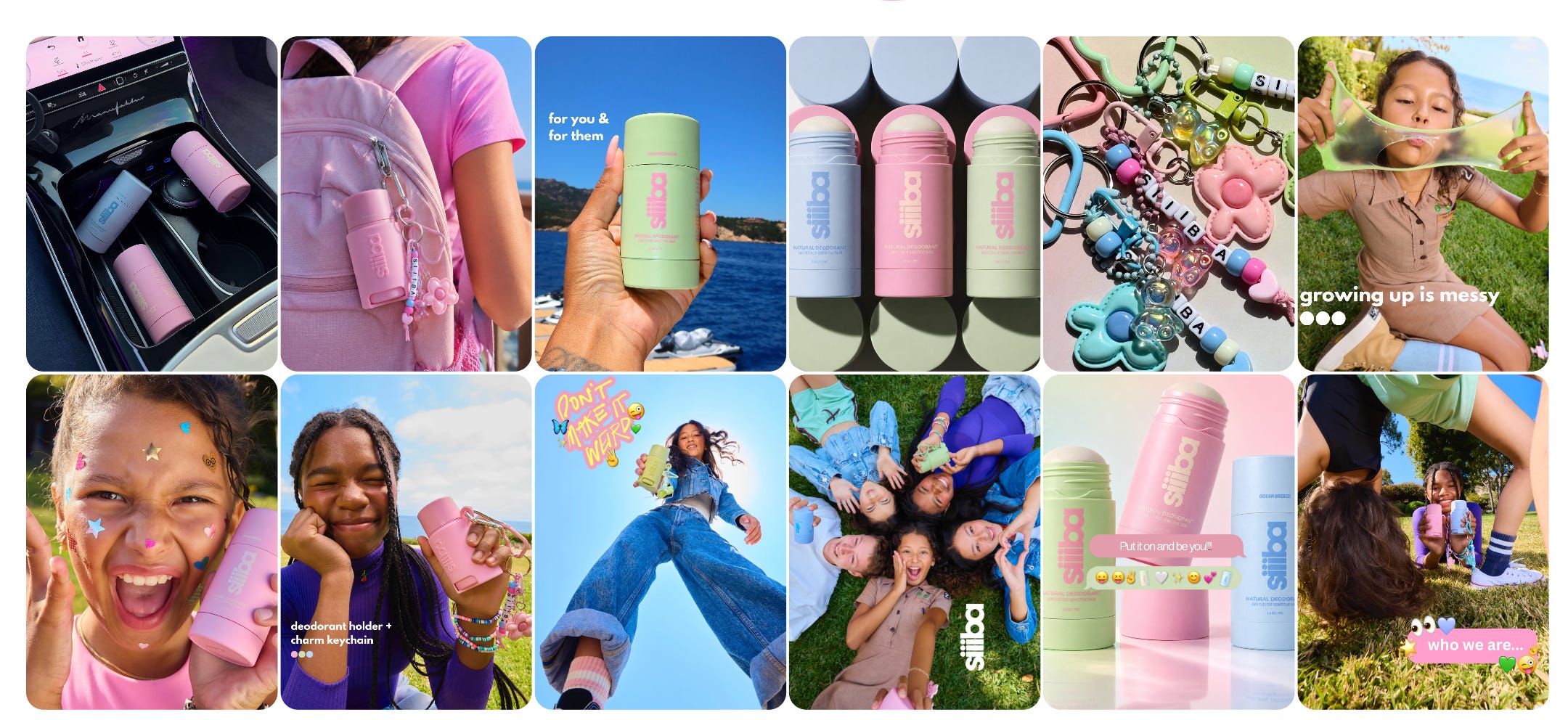
We were watching The Girls (please don’t judge us) when Yris Palmer mentioned launching a kids’ deodorant line because, we’re paraphrasing here, kids are stinky. Hulu released all six episodes on August 21, and her line Siiiba launched six days later.
GingerSpark: None of this is totally new…most of us can kinda remember the first Dove or Ban deodorant ad we ever saw in a magazine or on television. The newness is that the category actually became tween-centric instead of “shrinking and pinking” her mother’s deodorant. Founders are now focusing on solution-oriented formulas that she can grow into, that are gentle, and that even message boys who were left behind. Bodily functions like sweat and odor aren’t things that need to be apologized for. This is the same driver and the same sentiment we described in Destigmatized Care, Finally Out Loud. A product that was then seen as a mere functional, personal item now arrives as a kid-focused wellness solution.