
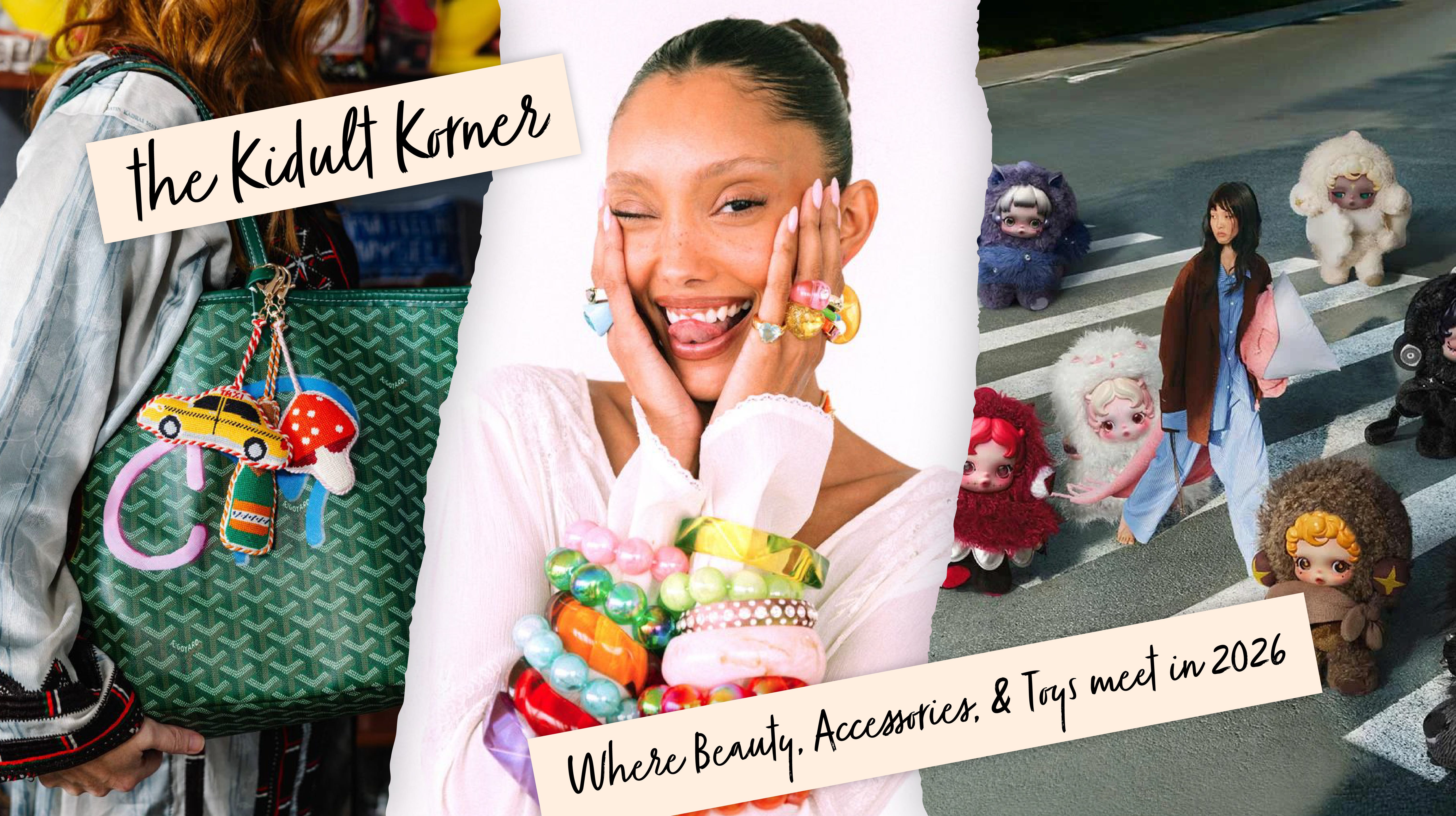
The Kidult Korner: Where Beauty, Accessories, & Toys Meet in 2026
Serious Design, Not-So-Serious Energy
The toyification of beauty, jewelry, and accessories is playing out globally, driven by kidcore aesthetics and nostalgia-led design. Following Pop Mart’s Labubu phenomenon, playful textures, chunky beads, colorful enamel, charms, and whimsical motifs are scaling up in size and visibility. Oversized, joyful designs are replacing delicacy, blending traditional materials with kitschy, childlike elements that prioritize self-expression and fun.
Playfulness, Personified
As part of Pinterest Predicts™ 2026, Pinterest identified Gimme Gummy, forecasting that Gen Z and Millennials are fueling an ASMR-led obsession with gummy textures, from bendy phone cases to elastic cheek tints, rubberized nail art, and 3D jewelry. Pinterest reported sharp increases in searches for the jelly candy aesthetic (+100%), the gummy bear aesthetic (+50%), and the jelly blush aesthetic (+130%).
Trade voices are reinforcing the shift. WWD Beauty Inc. has increasingly tracked how beauty brands borrow cues from toys, reframing products as collectibles, customizations, and emotionally resonant experiences. In an Instagram post highlighted by Beauty Inc., Nick Mowbray, founder of Zuru, explained that beauty products are becoming “characters and companions,” not just functional tools.
In May, WGSN (Worth Global Style Network) formally identified this shift as The Kidult Consumer, pointing to adults’ growing appetite for playful design, novelty, and emotional comfort across categories. Shortly after, Business of Fashion posed the question, “Who Would Pay $20,000 for a Hamburger Ring?”, using fine jewelry as a case study for how novelty and humor are gaining legitimacy at the high end.
Enable 3rd party cookies or use another browser
Beauty trade outlet MakeUp New York further reinforced that beauty is extending the toyification trend, as consumers seek moments of joy, play, and personalization in everyday routines. Personalized charms and keychains have emerged as a low-barrier entry point. They are tactile, expressive, and easy to remix.
Hourglass leaned into this with the Charms Edition of its Ambient Lighting Edit Palette, supported by a Selfridges-exclusive pop-up where shoppers could customize palettes with charms. Similarly, Tarte introduced “mystery charms” alongside its holiday Maracuja lip launch, emphasizing collectibility and surprise.
In luxury, Valentino recently unveiled its Blue Spike Collection, which includes a collectible keychain set slated for 2026, signaling that toyification is moving well beyond mass and prestige.
Key Characteristics of Toy Inspiration
Beyond jelly textures, material play defines this movement. Traditional metals are paired with bright enamel, colorful gemstones, and mixed materials to create bold, chromatic expression. Charms and personalization will continue to anchor the trend heading into 2026, echoed by Michael Rider’s debut at Celine during Paris presentations at Printemps.
Looking ahead, expect summer camp craft references to surface across accessories. Florals, animal charms, and kitschy embellishments are already appearing on bags and jewelry, including Prada’s sparkly pocketbooks spotted in Soho. Bag keychains, oversized cocktail rings, chunky cuffs, and statement earrings will be widespread, often with geometric or avant-garde forms that feel closer to wearable art than traditional adornment.
Why It Matters
Toyification signals the rise of a new class of little luxuries. These pieces offer accessible personalization and moments of fun that feel intentional rather than indulgent, allowing consumers to engage with the designer conversation without a full look or major spend.
The behavior mirrors earlier Millennial collecting moments, from Beanie Babies to Pokémon cards, where emotional attachment, scarcity, and identity signaling drove repeat engagement. The instinct hasn’t changed, only the format. Today’s collectibles live on vanities, handbags, and keychains, serving as small but expressive markers of taste and cultural fluency. As statement pieces, toyified designs quietly rebel against restraint while remaining socially legible. They are designed to be noticed without being loud, keeping consumers coming back for pieces that feel joyful, collectible, and of the moment.


