


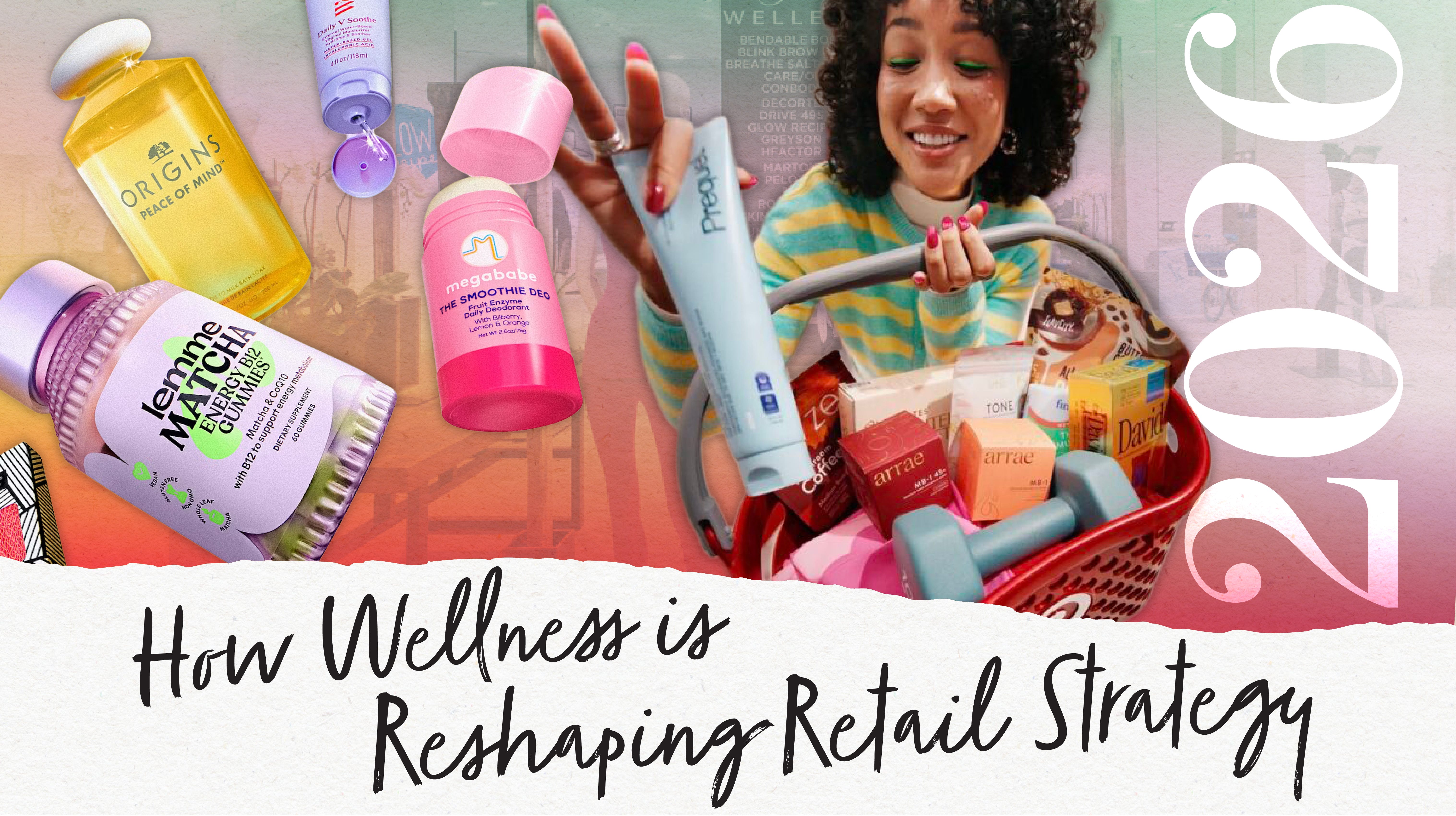
Wellness is not resurfacing as a trend revival. It is consolidating under pressure. After years of fragmentation across clean beauty, self-care, biohacking, and lifestyle optimization, wellness is returning to the center of the cultural and commercial conversation. This time, it is less about aspiration and more about function.
We have seen a version of this before. In the late 2010s, wellness was positioned as retail’s growth engine as traditional beauty began to slow. Who remembers when Saks Fifth Avenue launched The Wellery, a 16,000-square-foot immersive concept blending fitness classes, meditation, supplements, skincare, and fashion in one environment? The idea resonated culturally, but unfortunately, the limitation was structural. Wellness worked as a destination but not yet as a system. Without sustained education or routine-building, it skewed toward the experiential rather than the habitual. We have to ask the honest question. Was ConBody what consumers needed inside a department store? Were shoppers realistically heading to Saks after work to exercise? In hindsight, especially given Saks’ financial struggles, the model feels misaligned.
It is also worth remembering that even earlier, in the mid-2000s, Duane Reade began expanding its beauty and wellness positioning in New York, redesigning stores with elevated beauty departments, broader supplement assortments, and more lifestyle-oriented merchandising. The ambition was similar: wellness as a traffic driver; wellness as a differentiator. The structural challenge was the same then as it is now. Execution without long-term system-building rarely holds.
At the same time, quieter operators were building a different blueprint. Jessica Richards focused on credibility-first wellness assortments at Shen Beauty and later shaped Free People’s wellness category around efficacy, education, and lived relevance rather than spectacle. Shen’s influential Brooklyn boutique ultimately closed its brick-and-mortar doors in 2023 and shifted online amid financial pressure. The closure underscored how difficult it is to sustain experiential retail, even when the curatorial vision is ahead of the market. Today’s resurgence is unfolding under very different conditions.
From Aspiration to Infrastructure
The current return is being driven by stress, longevity anxiety, and the normalization of maintenance over miracle. Consumers are not chasing transformation. They are building routines. Ulta’s expanded Wellness by Ulta Beauty program reflects that shift. The assortment is organized into four pillars: Nutrition and Supplements, Intimate Care, Rest and Reset, and Essential Routines. The structure is designed for repeat behavior rather than discovery theater, supported by trained wellness advisors who reinforce education and trust. The elevation of Intimate Care from edge category to core pillar is particularly telling. As mentioned in Destigmatized Care, we identified intimate wellness as inevitable nearly a decade ago. Its central placement now signals maturity rather than novelty.
Target is reinforcing the same thesis at mass scale. The retailer is introducing more than 1,000 new wellness products across supplements, skincare, fitness, and nonalcoholic beverages. Supplements anchor the strategy within a 21 billion dollar category, and most of the 2,000 new wellness SKUs are priced under 10 dollars to keep access broad. Not to mention, we pitched a Gen Z and self-care concept to Target in 2020. 👀 Some ideas just take a few years to land.
What makes Target’s expansion especially notable is how integrated it has become. The assortment now spans influencer-led supplement brands like Lemme, activewear from Blogilates’ Cassey Ho, hair wellness from Ashley Tisdale’s Being Frenshe, men’s grooming from Papatui, and wellness technology, including Therabody SmartGoggles and the Oura Ring 4. According to the retailer, more than 140 wellness tech items are now in the assortment.
Nonalcoholic and functional beverages are also gaining prominence, reflecting the sober curious movement and broader health awareness following the U.S. Surgeon General’s recent push for cancer warnings on alcohol. Wellness is no longer confined to pills and powders. It is expanding into lifestyle architecture.
Amazon and TikTok Shop are seeing wellness sales surge without immersive retail environments, while Sephora is stepping back from supplements to refocus on core beauty. The category is not universally aligned, but it is clearly active again. The bigger signal is channel expansion. Supplements grew 42 percent on Amazon to reach $16.5 billion in 2025, according to MarketDefense, while health products on TikTok Shop rose 70 percent to $623.3 million, per Charm.io. Wellness is scaling digitally without the need for experiential square footage.
What feels different now is not who is participating, but how they are participating. The conversation has shifted from spectacle to infrastructure. Retailers are building systems that support repeat behavior, education, and trust rather than relying on immersive moments.


Pressure Is Driving the Return
The forces pulling wellness back to the center are structural, not cyclical. Longevity has become a primary consumer priority, with 60 percent of consumers ranking aging healthily as a top or very important goal according to McKinsey 2025. Emotional well-being is inseparable from beauty. Stress, sleep, and nervous system regulation shape how consumers look, feel, and age.
The behavioral data reinforces the urgency. Forty percent of Gen Z report feeling almost always stressed. Chronic stress can shorten life expectancy by nearly three years. Social signals mirror that pressure. Instagram posts tagged ‘stress-relieving’ are up 261% year over year. TikTok interest in stress-modulating ingredients continues to climb, with adaptogens up 505 percent, magnesium up 50 percent, and lavender up 18 percent.
As we have reported in Meet Them Where They Are: Embedded Retail for a Post-Mall Generation, brands are responding earlier and more strategically. Beauty and wellness players, including Ulta Beauty, Sephora, Bubble, and Poppi, are increasingly appearing on college campuses. As brands intensify their focus on Gen Z, campuses have become a strategic proving ground.
Internationally, the shift is visible as well. Liberty of London has transformed its storied atrium into a modern wellness destination built on trust and curation rather than spectacle. The assortment includes @wildnutritionltd, @weare.valerie, and @ancientandbrave. As Wizz Selvey, co-founder of Valerie and former head of buying at Selfridges (@theofficialselfridges), has noted, the ambition is for Liberty to become a trusted wellness authority, as it has long been for beauty.
Further, Boots is rolling out dedicated wellness zones and expanding its wellness assortment in stores to help customers navigate sleep, hydration, gut health, movement, nutrition, and beauty from within with expert guidance. Over 500 Health & Wellness Specialists have been trained, and more than 140 stores now feature these curated zones alongside new wellness lines, including own-brand and trending products.
Why This Matters
Wellness is back at the center because the conditions demand it. Stress, longevity, and emotional regulation are shaping how consumers spend and how they build daily routines. But wellness is NOT transactional. It requires time, repetition, and reinforcement. It is habitual by nature. Real change, whether better sleep, improved mood, or healthier aging, is built slowly and sustained through consistency. Retail has a role to play here. Most consumers do not walk in knowing exactly what they need. They feel the symptoms before they understand the solution. The opportunity is not just to sell products, but to create clarity. To organize, educate, and guide! The next phase of wellness retail will belong to those who help consumers build practices, not just baskets.
