


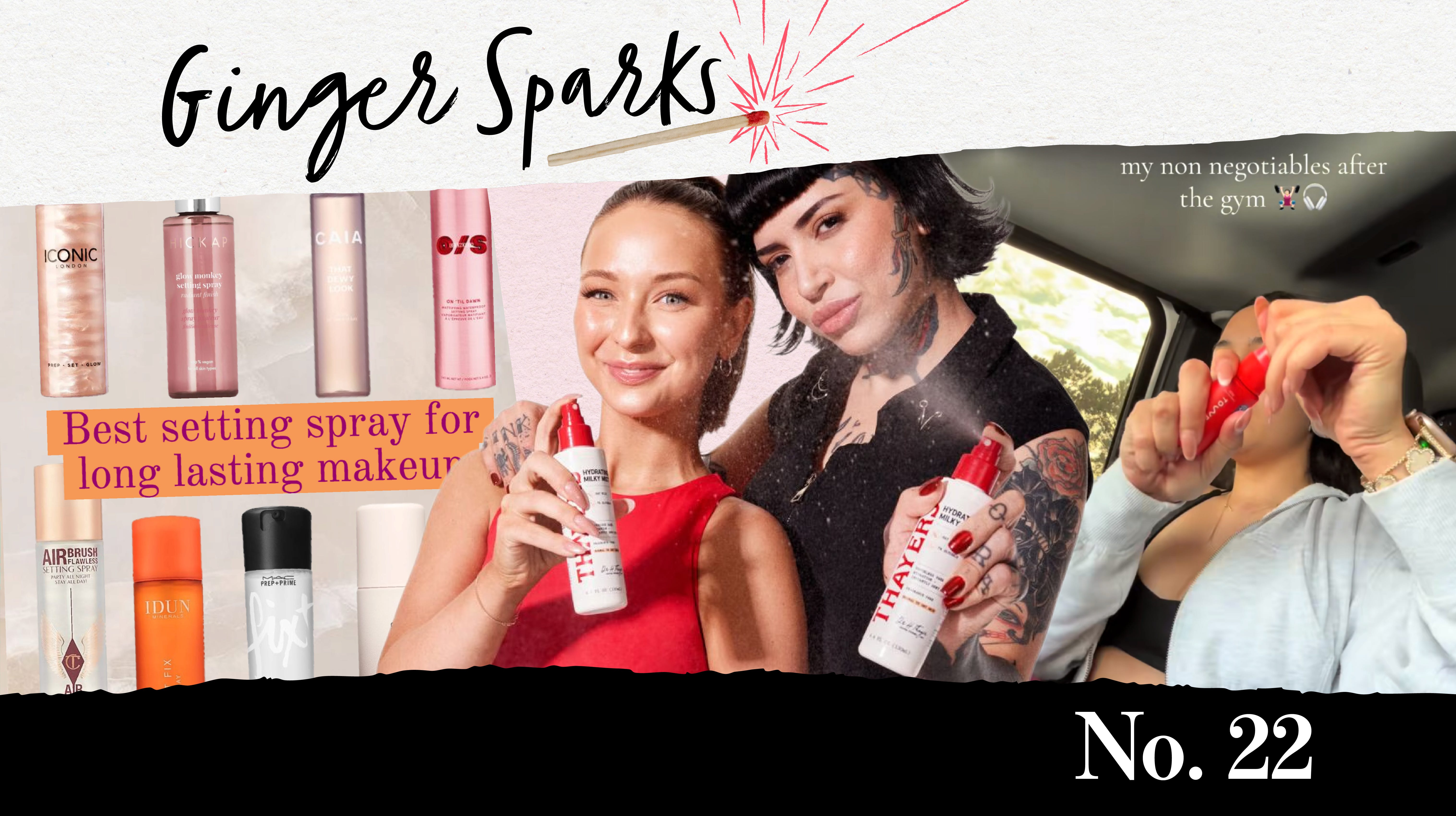
The face mist has been quietly changing jobs. What started as a makeup finisher is now a post-workout essential, a barrier-repair tool, and, apparently, the product category most likely to be invented in a comment section.
The Gym Bag Is Now a Skincare Bag
We have long argued that the on-the-go beauty edit deserves the same serious attention as any other skincare category. The gym bag, the car console, and the locker room shelf are real skin moments that the traditional morning-night routine ignores entirely. TikTok is now giving that argument a product vocabulary.
Anyone who has sat in a treatment chair pre-laser knows the smell. Slightly chlorinated, faintly like a pool, clinical in a way that feels both sterile and strangely reassuring. That is hypochlorous acid, and it has been doing its job in treatment rooms long before TikTok gave it a gym bag.
The after-class spray moment now has a product. HOCl saw 2,100 percent year-over-year growth in body care, according to Spate’s 2026 Ingredients Trends Report. Search “face spray for after hot pilates” and dozens of videos surface with the same framing: you finished your workout, your skin is compromised, and this product fixes it. On Sephora’s Facebook, a Tower 28 video that has pulled 82,000 views names it for post-workout and post-procedure recovery (a connection we explored in Ginger Sparks No. 15).
HOCl is not a TikTok ingredient that happened to find clinical validation. First synthesized in 1834 and used as a wound disinfectant in both World Wars, it is produced naturally by white blood cells and has been used in hospital wound care long before it landed on a Sephora shelf. Benzoyl peroxide has been the clinical gold standard for acne for decades, and a Journal of Integrative Dermatology review found that HOCl matches it for mild-to-moderate inflammatory acne, without the dryness or irritation. Dermatologist @dermguru called it a hygiene hack she refuses to gatekeep, keeping a bottle of Think Smarter Products Multi-Use HOCl Spray in her gym bag after every sweat session. (The ASMR on this one is doing at least half the work.)
Tower 28’s SOS Daily Rescue Facial Spray ($28) is formulated with three ingredients: water, sodium chloride, and hypochlorous acid, the result of eight years of formula stabilization. The dupe conversation runs in parallel, with comparison videos pulling millions of views. Mario Badescu’s Repairing Facial Spray carries the identical formula for less. Prequel’s Universal Skin Solution ($17) adds magnesium and electrolyzed water for $11 less than the original. (Prequel is also behind the vitamin C serum that became our SkinCeuticals C E Ferulic dupe of choice, so expectations are high.) For those who want a more clinical formulation, Briotech Topical Skin Spray sits closer to the medical-grade end of the HOCl spectrum.
Ginger Spark: HOCl spent a century in hospitals and wound care before maskne put it on the consumer radar, and the gym bag is where it found its permanent address. Fitness culture has created a third-skin moment that the traditional morning-to-night routine never addressed. Sweat, heat, shared surfaces, and the gap between finishing a workout and getting home to cleanse properly are real biological events with a real biological answer. The brands that understood the science before the behavior had a name are the ones earning shelf space in the locker room right now.

The Spray That Started in the Comments
For a brand founded in 1847, Thayers moves fast. As Glossy reported, creator Nina Pool noticed the buzz around the One/Size Powder Melt Glass Setting Spray and realized she wanted that sprayable, touchless format in a milky skincare product. Pool has autism, and anything requiring hands-to-face contact is a dealbreaker for her. She tagged makeup artist Shelby Ann Bell, who headed to the drugstore that same day, mixed the existing Milky Toner with water, and poured it into a spray bottle. It was too thick to mist. But the comment sections erupted anyway. Thayers posted a response video asking, “Should we make a milky mist?” It got 15,000 likes and nearly 1,000 comments, and actually led to the formulation of something new.
The Hydrating Milky Mist launched May 1, 2026, at $14.99 and became Amazon’s number one new beauty release within 24 hours. Oat milk and 7 percent glycerin, fragrance-free, non-sticky, barrier-focused, and the word “touchless” made it onto the front of the bottle. The glycerin and oat milk reel is doing the product more justice than any press release could. The milky format had been in development long before this launch. We tracked the resurgence of milk-based rituals in Farm to Future last August, and Violette_FR’s Boum-Boum Milk launched in 2021 with almost no marketing and built a cult following entirely on its own, earning Best Skincare of All Time recognition long before milky mists became a conversation. The global face mist market is projected to reach $1.5 billion by 2034, and a 175-year-old witch hazel brand just proved that the fastest path to a launch is still paying attention.
Ginger Spark: Pool was not chasing a moment. She was solving her own problem, and a community of thousands confirmed it was theirs too. That is the difference between a product that earns loyalty and one that just earns a launch. The best brief is the one already written by the people who need the product.
The Mist That Forgot It Was Makeup
The setting spray had one job. Lock the face, extend the wear, done. Skindinavia, the indie brand credited with bringing the consumer setting spray to market, built the formula that Urban Decay’s All Nighter ran on for 15 years. We used to pick it up at the Makeup Show and at Manhattan Wardrobe Supply long before it became a drama. When L’Oréal reformulated the All Nighter without them in 2025, the Skindinavia post announcing the split got 100K likes. Beauty enthusiasts weren’t loyal to the Urban Decay name—they were loyal to what was in the bottle.
The category was always two things. Some sprays lock makeup in place: Urban Decay All Nighter, One/Size, Charlotte Tilbury Airbrush Flawless. Others hydrate and refresh. MAC Fix+ has always been the second kind, and people figured that out long before the marketing did. Milk Makeup Hydro Grip, one of our favorites, made the skincare case explicitly: blue agave, hyaluronic acid, niacinamide, and hemp seed oil in a setting spray. The line between setting spray and skincare mist dissolved so gradually that no one noticed it was gone. The interesting question is no longer which mist makes makeup last longest. It is which one you actually enjoy using
Ginger Spark: The setting spray was invented by an indie brand, scaled by a corporation, and when the corporation replaced the formula, 100K people reminded them that the ingredient story was always the point. That logic runs through the entire mist category right now. The winning products are those built around a real skin need rather than a format convention. The spray is no longer a category. It is a delivery system that follows the skin moment wherever it goes.
