


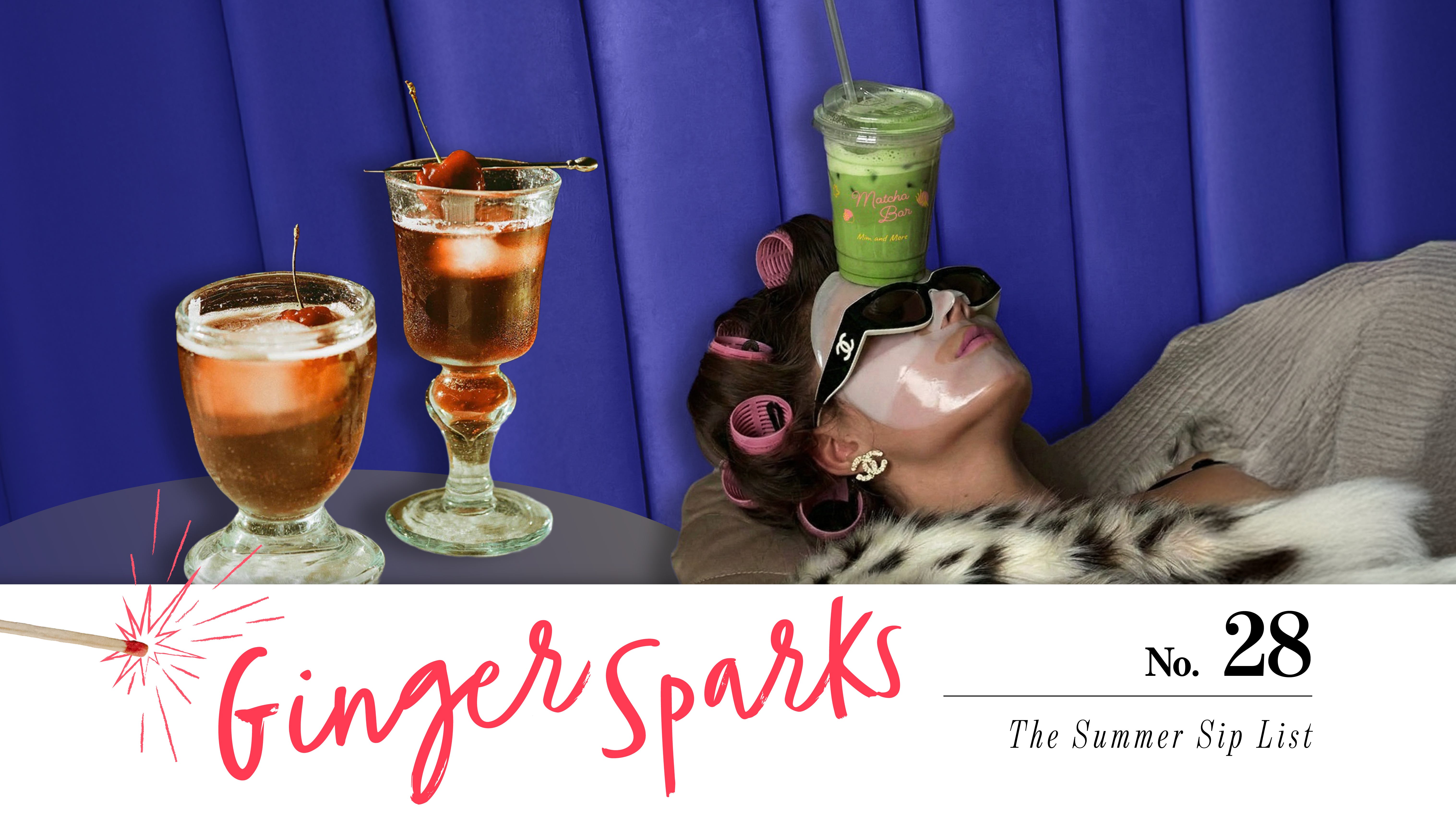
Something has shifted in what we reach for throughout the day, and it isn’t just the usual coffee pick-me-up. Drinks have become their own wellness ritual, with consumers hunting for options that feel as health-conscious as they are satisfying, without giving up the dopamine hit that soda and alcohol used to deliver. And the beverage brands have noticed. They’re building more functional formulas while nailing the aesthetics that Gen Z and Alpha expect at first glance. Below, we break down three categories of drinks people reach for throughout the day, plus a few entries from our own Daily Sips list.
The Hydration Handoff
For a lot of people, coffee comes before food, not after. The Long Run built hydration into that first cup instead. One of the newer names in the functional coffee space, it blends the electrolytes sodium citrate and potassium gluconate directly into its grounds, a combination it says improves hydration and helps keep energy steady. The amino acid L-Theanine is commonly used to offset caffeine’s jitters, answering one of the oldest complaints about coffee.
Matcha has become the go-to alternative for people looking to skip the caffeine crash altogether. Strawberry Matcha is everywhere on Instagram right now; its pink and green layers are built for the scroll. Matcha carries caffeine too, though it’s often described as releasing more slowly, easing the transition off coffee without losing the lift. Demand now outpaces what Japan can produce: production tripled between 2010 and 2023, and producers still struggle to meet the surge, with new tariffs on Japanese imports pushing prices even higher. The price stings close to home too: $7.25 for the smallest Matcha Coconut Cloud at L’Insolent Cafe in West Nyack, just north of Manhattan in the Lower Hudson Valley. None of that dents the appeal. That cup delivers what feels like a small dopamine hit dressed up as self-care, and the pillowy green swirl turns an ordinary errand into main-character energy.
This summer, coconut water became the go-to mix-in for both matcha and espresso-based drinks. Coconut water contains key electrolytes, namely potassium, which can support hydration during the summer heat. New York City spots like Matchaful, Bake Culture, and Rhythm Zero have their own versions on offer, with flavors ranging from Ube to Strawberry and beyond. The format is traveling well beyond the city too. One creator recently recreated her own coconut water matcha at home after discovering the drink at a cafe called Common Supply in Australia.
Ginger Spark: Hydration is a key part of feeling like your best self, so incorporating it into your morning dopamine routine is becoming increasingly common. In this same vein, whole foods and traditional ingredients, such as matcha powder sourced from Japan, are heavily favored by Gen Z and Alpha as they start their day. These drinks are also built with another audience in mind: the feed. With social media serving as one of the main marketing channels for younger generations, cafes are adding bright pops of color to match the aesthetics of the spaces they occupy, no matter the zip code.


Perks You Can Pour
Somebody in workplace experience got a budget, and the office fridge is the proof. Generic soda and gas station energy drinks didn’t make the cut, pushed out for something with better branding and an actual health halo. In their place: Olipop, Poppi, Wildwonder, local cold brew from names like Rise and La Colombe, and adaptogenic hydration. The $2.49B office coffee service market sells itself on the cost of keeping employees on-site, pitching premium coffee and snacks as a reason to actually show up. Employers are installing high-end machines, and WeWork brought in on-site baristas across 26 of its buildings through the social enterprise Change Please.
The drink selection isn’t random, and neither is the audience. Beverage providers catering to specialty and adaptogenic tastes are well positioned to retain younger workers, at least on paper. Citi’s lead beverages analyst, Filippo Falorni, told Fortune that pre- and probiotic soda now accounts for roughly 2% of the US soft drink market, close to $820M, with growth more than doubling in the last year. It’s moving into workplaces through micro-markets and “breakroom of the future” setups aimed squarely at Gen Z. That’s where the Gen Z selection actually lives, as a retention play rather than a taste profile. With employers pushing remote workers back to their desks, the office fridge doubles as a return-to-office strategy.
Except the numbers say the strategy isn’t landing the way employers hoped. Nearly half of hybrid workers (44%) admit to coffee badging: swiping in, grabbing the free coffee, and leaving before the workday really starts. Three out of four companies say they’re struggling to stop it. The office can buy the coffee run, but it can’t buy the return.
Ginger Spark: Highsnobiety’s recent Status Economy report found that 71% of Cultural Pioneers now see groceries as a form of cultural capital. The office fridge is stocked with groceries and a badge reader, and employees are reading it whether leadership means them to or not. As a fully stocked fridge becomes a baseline perk rather than a bonus, employers are already raising the stakes, adding subsidized meals and fitness centers to buy more than a coffee run’s worth of loyalty. Whether that buys anything more than the fridge did remains to be seen.

The Ritual Without the Buzz
Count the drinks at a table of 25-year-olds tonight, and chances are a few of them won’t have alcohol in them. That doesn’t mean the table’s boring. Some are zebra striping instead, alternating a cocktail with a mocktail throughout the night rather than cutting alcohol entirely. The pullback comes down to two pressures: one about the body, one about the bill. Bars have noticed. Ordering off the mocktail menu now gets the same care as ordering a cocktail.
Brands know the swap is happening, and they’re building for it. Hiyo, De Soi, and Recess Mood load their cans with ashwagandha, lion’s mane, L-Theanine, and magnesium, selling the ritual without the next-morning tax. TRIP built an entire adaptogen sparkling line on the same bet. The functional beverage market is on course to reach $250B globally by 2030. The catch: a Geisinger physician notes the claims about stress and sleep behind these adaptogens still need rigorous research to back them up.
Then there’s the can that’s neither beer nor mocktail. Cannabis drinks read the same in the hand at a backyard party, and the swap is measurable. A 2026 University at Buffalo study found people who picked up cannabis drinks cut their weekly alcohol intake by roughly half. The category is splitting into lanes: seltzer swap, cocktail swap, social spritz.
Functional drinks have also opened up a fourth lane: the sleepy girl mocktail. Calee Shea first posted the combination on TikTok: tart cherry juice and Olipop, and it went viral again after creator Gracie Norton added magnesium powder to the mix. The blend is designed to calm you down and help you sleep, and it’s already become a category of its own, with brands like Vitamin Shop and Moon Juice creating their own versions.

Ginger Spark: What’s really happening here isn’t a rejection of any one substance; it’s a shift toward picking effects on demand. The same person swaps in caffeine for one hour, magnesium for another, and THC for a third, treating each drink as a dial rather than a default. The brands capturing Gen Z’s attention are the ones building for that specificity. Ritual built its own answer to the sleepy girl mocktail, a ready-to-mix magnesium powder designed for the wind-down end of the dial. Woodstock Goods’ THC seltzers sit at the opposite end, built for the social high rather than the quiet one. Functional drinks have stopped being a passing fad and started acting like a toolkit, one where the consumer picks the tool to match the moment.
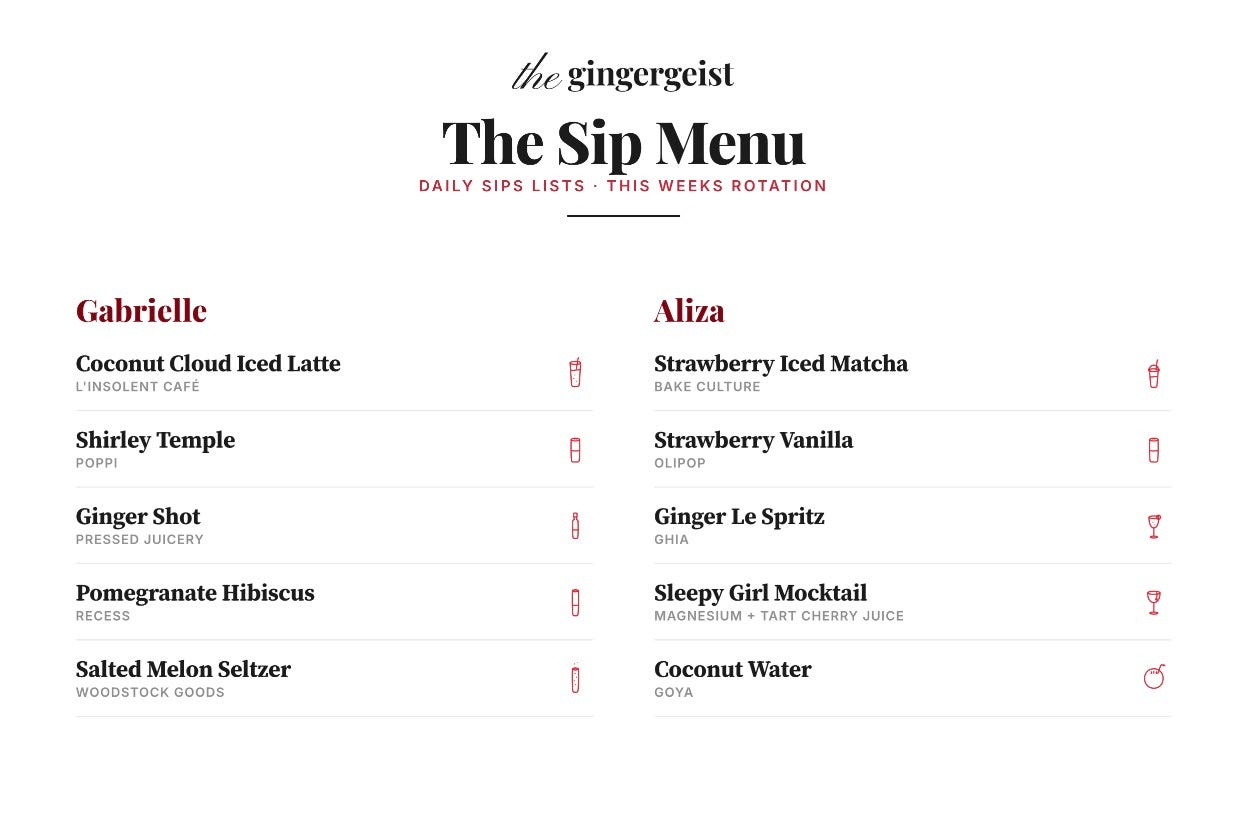
Gabrielle and Aliza do double duty at Gingergeist, marketing and regulatory reporting on one hand, resident Gen Z experts on the other. So when we promised a Daily Sips list, we handed it straight to them. Here's what's currently living in their heads rent-free, no theory attached, just what they're actually drinking!
Before you close the tab: if something in here felt true, restack it. That is how Gingergeist reaches the Cultural Pioneers who haven’t found us yet.
🔄 Restack if you’ve got a drink in rotation that’s outlasted every trend around it.
❤️ Like it so the algorithm works in our favor for once.
📧 Forward it to the friend who’s been zebra striping before it had a name.
💬 Drop your own Daily Sip in the comments. The sharpest ones become the next edition.
📱 Follow gingergeisty on Instagram.
