


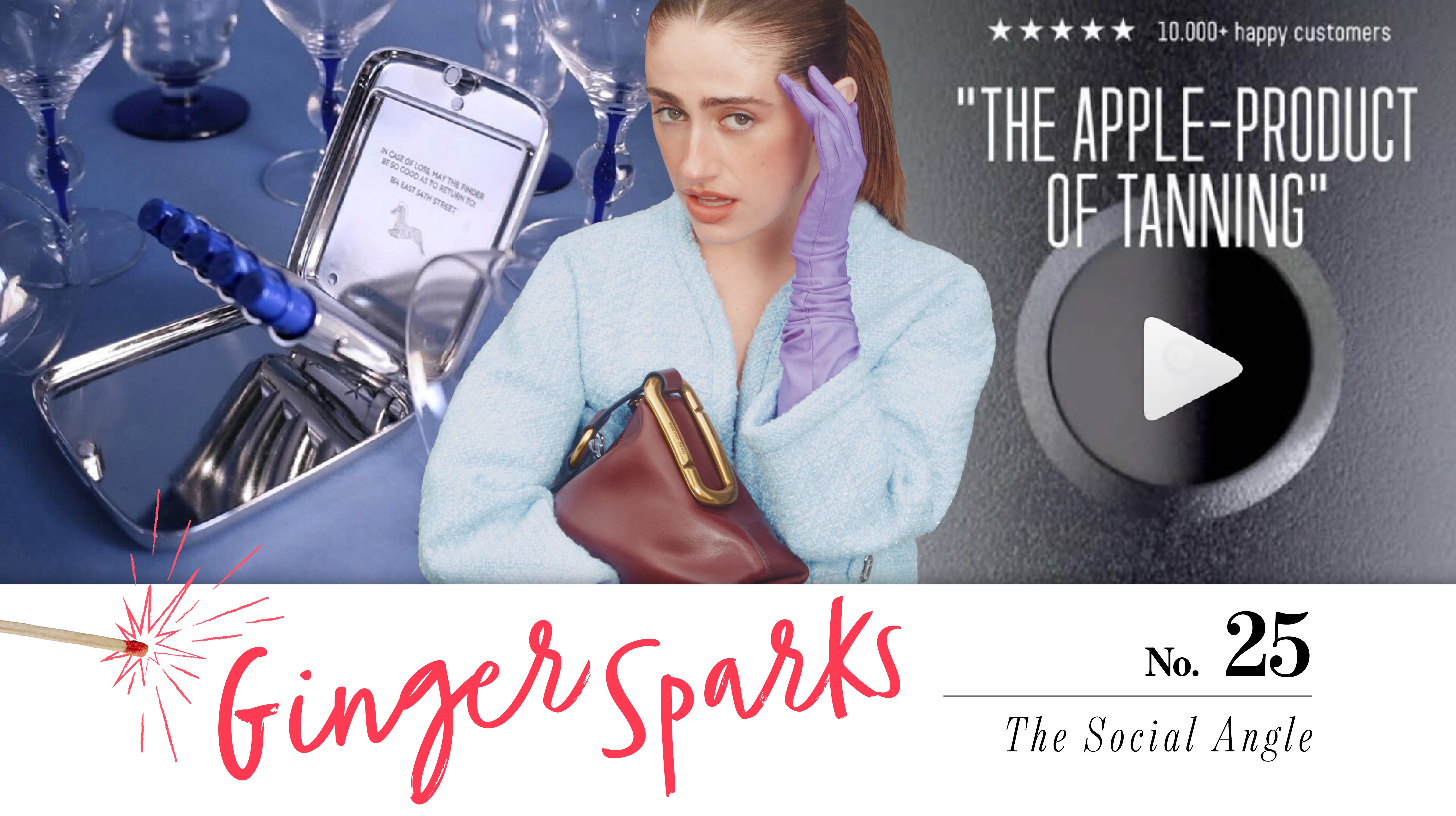
This week, beauty couldn't stop borrowing. Brands dressed up as tech giants, moonlighted as TV studios, and time-traveled to Old New York, all to sell a feeling instead of a face cream. Here are three brands renting someone else's playbook to build their own myth.
The Apple of Their Eye
Recently, an Instagram post from COMIS, the Swedish beauty-tech brand (launched in 2021) known for its nanotechnology, misting devices, and self-tanning capsules, caught our attention. With prominent logos for Vogue, Elle, and InStyle, the post read, in all caps, “THE APPLE- PRODUCT OF TANNING.” Hmmmm… Where had we seen something like this before? Michelle quickly recalled the 2014-to-2016 era. In our consulting days, “the Uber for ___” showed up in roughly every other deck that crossed our desks, usually somewhere near the word “disrupt.” Interestingly, back in February 2023, COMIS had launched disposable skincare pods, touted as a “Nespresso for beauty” concept.
And they’re far from alone. Foreo has frequently been dubbed the “Apple of beauty devices,” known for premium pricing and design-focused engineering. APR, the South Korean company behind popular skincare devices like Medicube, made global headlines for its device-led strategy, with the founder openly stating the goal of building the “Apple of beauty tech.” Glossier went a step further and actually built itself like Apple. With minimalist, unboxing-forward packaging and a cult following that grew 600 percent year over year, it turned product drops into keynote-style launches, complete with fans sleuthing trademarks to guess the next release. Founder Emily Weiss even dreamed of "a beauty brand whose sweatshirt you wanted to wear."
Ginger Spark: When beauty brands compare themselves to Apple or Nespresso, it's a strategic branding tactic to shift consumer perception. By aligning with these iconic tech and lifestyle giants, they position themselves as modern, design-driven innovators rather than just makeup and skincare sellers. But there's a difference worth noting: some brands earn the comparison by building devotion (Glossier), while others borrow the name in a caption. The borrowed halo is the point, either way, invoke a brand people already trust, and you inherit a shortcut to credibility, desirability, and often permission to charge more.

Now Streaming: Your Favorite Beauty Brand
We’re still riding the high of the Marc Jacobs Beauty relaunch (covered in last week’s Ginger Sparks No. 24), but another recent Marc Jacobs Instagram post caught our eye for a different reason. It’s leaning into one of beauty’s fastest-growing social trends: serialized and episodic content. Brands are practically auditioning for the entertainment industry now, producing multi-part, narrative-driven content instead of one-off ads. Case in point, just before the Met Gala, Marc Jacobs dropped an episodic social series and campaign called “Question Marc,” written by and starring comedian Rachel Sennott.
And they aren’t the only ones writing a season. Earlier this year, beauty social leaned hard into comedy. Tower 28 brought on an actual TV writer to create a branded sketch series, The Blush Lives of Sensitive Girls, “a Tower 28 Original,” and the self-aware, pop-culture-savvy writing sent its engagement rates climbing.
Ginger Spark: If a brand isn't thinking in episodes yet, it may be leaving a real connection on the table, because storytelling is the hook. The format has even drawn comparisons to Latin American telenovelas and the booming world of micro-dramas, those short, vertical videos built for mobile feeds that run on heavy melodrama, rapid-fire cliffhangers, and the occasional forbidden romance. Creator @camillemoore breaks down this very Marc Jacobs post and explains why brands like CeraVe, Unilever, e.l.f., P&G, and Alexis Bittar are smartly betting on social-tainment. At this point, everything is content, and the lipstick is just product placement in its own ad.
Bottled Nostalgia
Allure recently spotlighted El Morocco Perfumery, a fragrance house inspired by one of New York City’s most legendary nightclubs. Founders Isaac and Lillian set out to bottle the glamour, escapism, and sense of belonging that defined a bygone era, and they’re refreshingly open about how nostalgia, storytelling, and a deep respect for the club’s legacy shaped every choice along the way.
From there, El Morocco Perfumery poured that same feeling straight into its social, carrying a piece of Old New York into the present through both the scents and the way they’re framed. One of their early posts leans all the way in: “Beckons adventure! Hints of intrigue! A daring fragrance collection with all the glamour of the internationally known sophisticates who sip champagne in the zebra-striped setting. Be first to thrill to the spicy excitement of it!”
Ginger Spark: The nostalgia is clearly landing. One devoted fan, @jessiejessup, put it better than any campaign could: “I just received mine yesterday and when i tell you i SCREAMED 😍😍😍 … it instantly reminded me of Proust, who famously wrote that ‘perfume is the last and best reserve of the past.’ … I am but a mere tater tot. Thank you again, profusely. You fill my heart and senses with rapture😍❤️👃”
El Morocco Perfumery had us with the vintage-inspired Travel Discovery Set, but the intersection of Art Deco packaging and duality of American swing/Latin music is simply transformative.
