


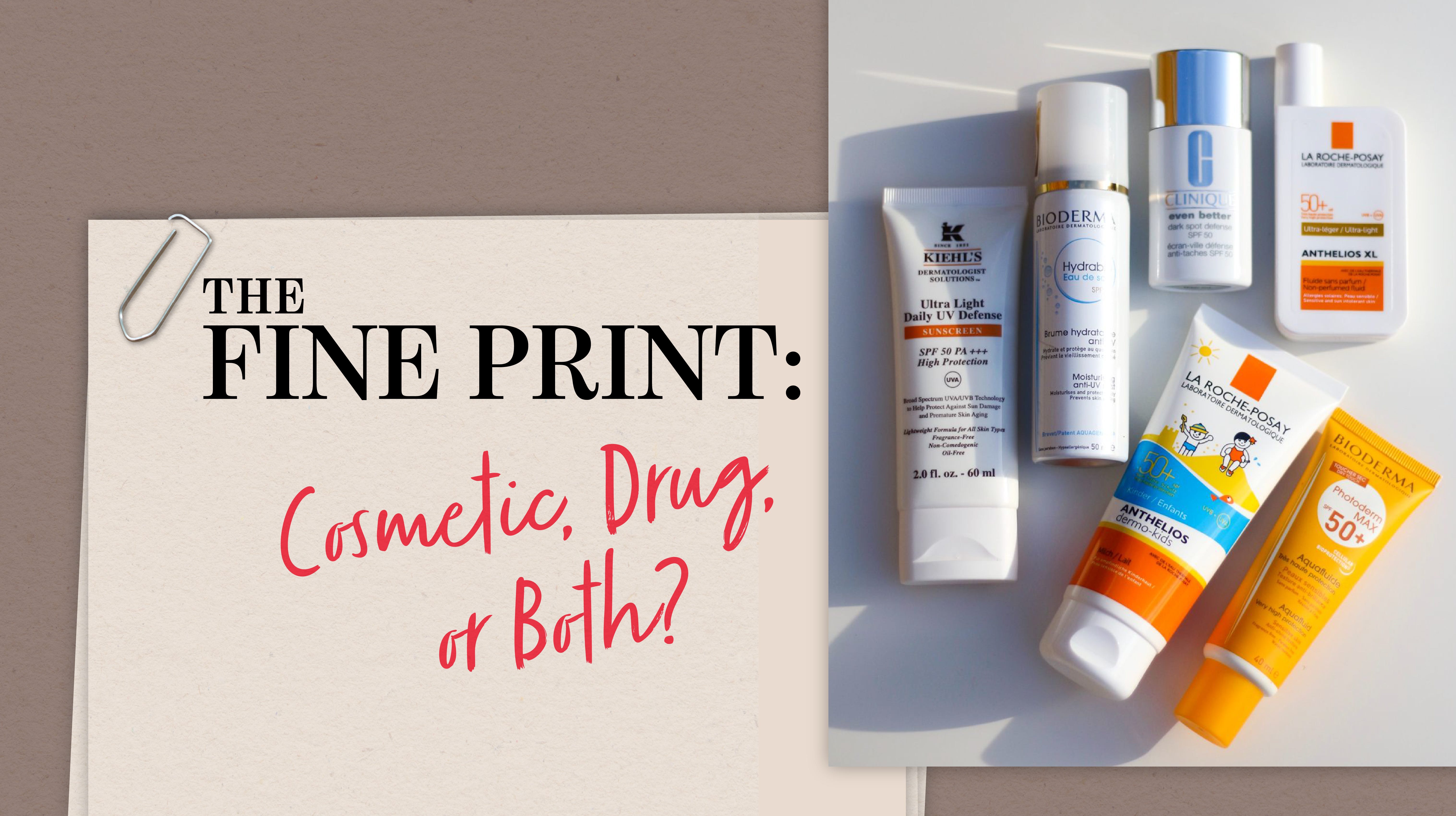
We’ve been waiting for the right person to take on the part of beauty no one wants to read and everyone should: the law. The fine print on the label, the reason your favorite ingredient is legal in Seoul, and the reason it’s missing at Sephora.
Meet Aliza. She’s applying to law school, reads the primary filings for fun, and is taking over the law corner of Gingergeist. The Fine Print translates the regulation shaping beauty, fashion, and wellness into something you can use, starting with why your suitcase comes home from Europe heavier than it left.
One ground rule: Aliza isn’t a lawyer, and this isn’t legal advice. She reports what a rule says and what got filed, never what you should do, and flags when a question needs a real attorney.
Now, the sunscreen.

Let’s talk about the section of your suitcase stuffed with your Euro pharmacy haul. Two kinds of packers, two kinds of heartbreak. Check a bag and the sunscreen explodes somewhere over the Atlantic, coating every outfit you own in SPF. Fly one carry-on only, like me, and the haul never gets that far: it dies in the security bin, a liquids dump at the gate. Michelle’s one wish for the June girls’ trip to Europe? A pharmacy run. Cue the panic!
Michelle and Jamie have written before about why our cabinets fill with sunscreen we never bought at the local CVS. From Korean hauls to Paris pharmacy sprees, sunscreen is the cult travel buy for those in the know. Nobody really explains why. Short version: the US added no new sunscreen active ingredient after 1999, Congress tried to fix it in 2014, and the ingredient the FDA finally proposed in December 2025 came through a different door.
Worth knowing what sunscreen actually fights, because it’s two rays. UVB burns. The American Cancer Society pins most sunburns and most skin cancers on it. UVA skips the burn: it penetrates deeper, hangs around year-round instead of spiking in summer, and ACS ties it to wrinkles and to some skin cancers. The catch is that the bottle measures SPF, which primarily rates UVB. A high number tells you how well you won’t burn, and nothing about the ray doing slower damage. The label that covers UVA reads “broad spectrum,” and a US sunscreen can skip that test and still sell, as long as the fine print admits it prevents sunburn, not skin cancer or aging. Europe closes that gap. The US shelves mostly leave it open.
Sunscreen: cosmetic, drug, or both? The US and the EU answered differently. The US went the drug route, citing sunscreen’s intended use as disease prevention (skin cancer) and a skin-altering product. Classification by intended reaches further than sunscreen: the same item can count as two things. Massage oil sold as a lubricant or fragrance is a cosmetic. Sold therapeutically, a drug.
Drugs are split into two classes: New Drug Applications (NDA) and Over-The-Counter (OTC). Sunscreen formulations, as OTC products, fall under the FDA’s OTC monograph system, a pharmaceutical cookbook listing pre-approved ingredients and formulations considered generally recognized as safe and effective (GRASE). The 1999 monograph, which never fully took effect, carried a “finalized list” that set SPF 30+ as the maximum labeled SPF value for monograph sunscreens. In 2002, the Time and Extent Application (TEA) process gave companies a path to pitch new ingredients for inclusion on the OTC list. The framework remained in effect, with at least eight TEAs pending by the time Congress noticed. The consequence? The active-ingredient list American formulators worked from dated to 1999.
The Sunscreen Innovation Act (SIA), signed on November 26, 2014, was meant to put the FDA on a clock: bipartisan legislation that set strict statutory deadlines for safety and efficacy review. In 2018, the Government Accountability Office (GAO) found all eight applications stuck in the backlog. The FDA wanted more safety and effectiveness data on each one: human clinical studies, efficacy studies, and the robust submissions OTC drugs require. Timelines rotated, but nothing underneath moved. Sunscreens are drugs that require drug-grade data. The freeze held.
Years before any of that, one brand had already found a side door. In 2006, L’Oréal walked La Roche-Posay’s Anthelios SX through the FDA’s new-drug application route, winning approval for ecamsule, a UVA filter Europe and Canada had sold as Mexoryl SX since 1993. The catch: the FDA cleared the finished products, not the ingredient itself, so ecamsule never joined the monograph, and no other US brand could use it. One filter, one company, one very expensive door.
The OTC monograph order request (OMOR) process, created under the 2020 CARES Act, restructured the framework around sponsor fees and direct industry filings. Industry sponsors set the pace instead of the agency. Fifteen months later, on December 12, 2025, the FDA issued a Proposed Administrative Order, the first proposed order it ever issued in response to an industry-initiated OMOR. The proposal: bemotrizinol (BEMT) at concentrations up to 6%, for adults and children six months and older.
“The agency has historically moved too slowly in this area, leaving Americans with fewer options than consumers abroad. We’re continuing to modernize the regulation of sunscreen and other over-the-counter drug products,” said former FDA Commissioner Marty Makary, M.D., M.P.H. “Americans deserve timely access to the best safe, effective, and consumer-friendly over-the-counter products available.”
Luckily for us, on June 9, 2026, the FDA issued the final order adding BEMT to the OTC monograph, the first ultraviolet filter added to the US monograph list in two decades. European and other global markets already use BEMT widely, including versions from Eucerin, Avène, La Roche-Posay, and Bioderma.
BEMT is the ingredient that answers that gap. The FDA’s order finds it works across both UVA and UVB and barely sinks into the skin, which is what broad spectrum means. For twenty years, US sunscreen has stayed good at stopping the burn and weak against the rays that age you, and don’t take the winter off. BEMT doesn’t raise the SPF number. It fills half of the spectrum that the US kept skipping.
What does that mean for your shelf and your suitcase? Nothing yet. The final order takes effect August 9, 2026, the day BEMT becomes legal to use in a US sunscreen, not the day a bottle with it lands at your CVS. Manufacturers still need to formulate and test so that the US shelves won’t change overnight. Adding BEMT moves the US one filter closer to the EU’s extensive Annex VI list. Formulators abroad already work from that larger palette.
It also explains the disappearing act on your own shelf. Beauty of Joseon sells a reformulated US version, while its original ships from overseas, and the originals keep moving through resellers like YesStyle, where importing a foreign-filtered sunscreen sits in a legal gray area. The tug-of-war between the formula you want and the one you’re allowed to buy is its own story. More on that, soon.
Why It Matters: BEMT is the first filter added to the US list since the late 1990s. The reason readers like you carry sunscreen home from Paris isn’t that European chemists are better. It’s the classification difference between cosmetics and drugs, and a single 1999 choice that set the pattern. The December 2025 BEMT order is the first evidence that the framework is starting to unclog. Whether it clogs again, on which ingredients, and how fast, decides what the next decade of American SPF shelves looks like. The signal showed up in December, and the confirmation in June. The rest shows up at checkout.
Before you close the tab
This is the debut of The Fine Print, so the honest question: do you want more of this? The single most useful thing you can do is restack it. That is how Substack hands a piece to readers who have never heard of us.
🔄 Restack this with the one rule you wish someone had explained sooner.
❤️ Tap the like so the next Cultural Pioneer finds it.
📧 Forward it to the friend whose carry-on comes home heavier than it left.
💬 Tell us what to decode next in the comments. The best questions become the next edition.
📱 Find us on Instagram at gingergeisty.
Not subscribed yet? New editions of the law corner go out by email. Subscribe so they find you!
See you in the fine print. Aliza
