


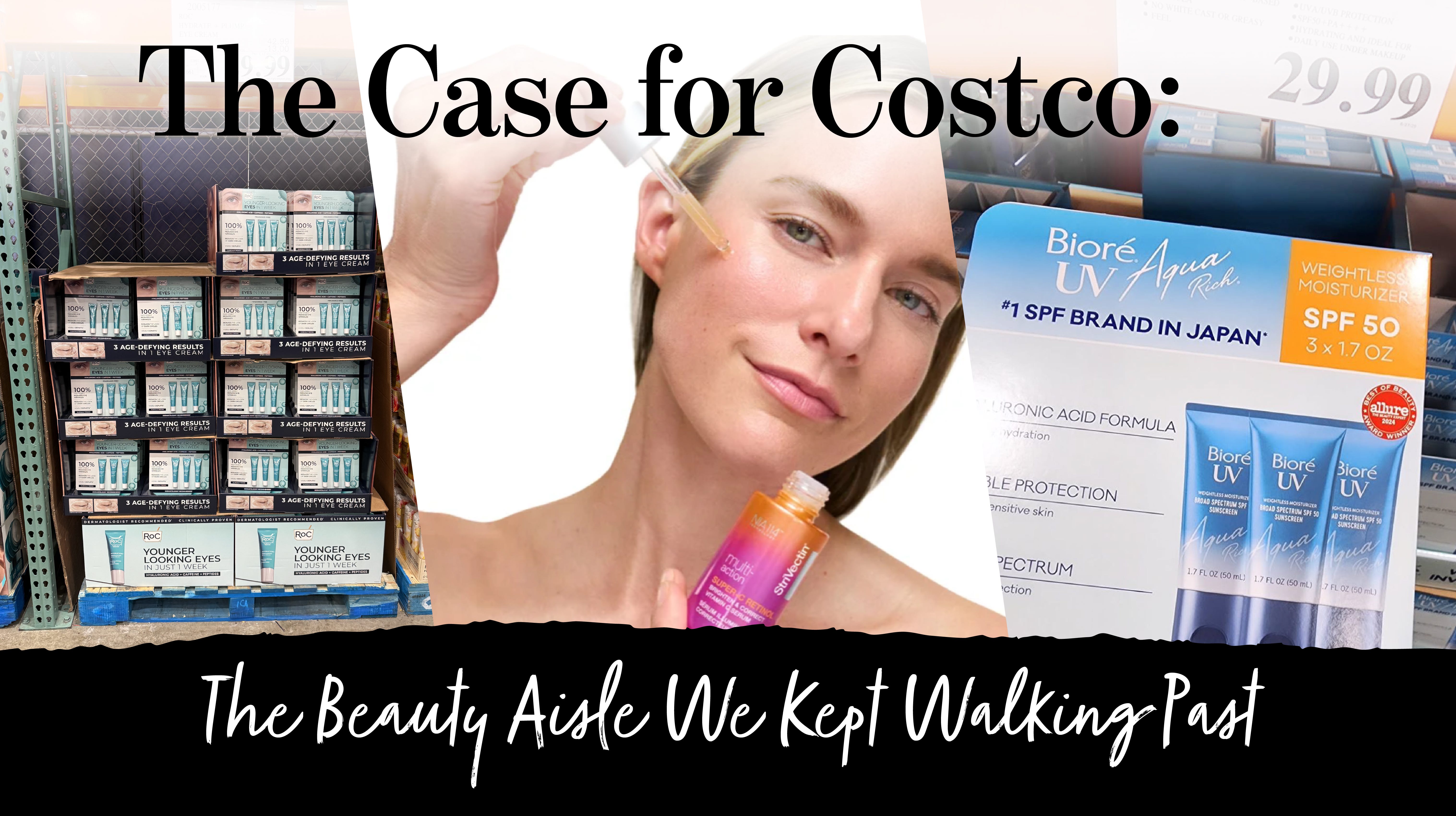
Here is something we should have said a long time ago: we have been Costco members for years ( at one point, they were clients), showing up for the butter croissants (trust us, they rival any fancy NYC bakery), the wagyu beef, and bulk Health-Ade kombucha….and mostly ignoring the beauty and wellness aisle the entire time. Leave it to our art director, Brittany, a self-described penny-pincher who buys her moisturizer, sunscreen, and cleansers in bulk at Costco, to make two beauty enthusiasts realize they had been walking past the most interesting aisle in the store.
She wasn’t sending dispatches from a trend safari; she was describing her own shopping habits, built around the practical reality that the warehouse carried serious skincare at prices that made the membership worth it on beauty alone. That sent us back to the aisles with different eyes, and what we found was not a shopping story. It was a cultural X-ray of where beauty consumers are right now and how deliberately they have arrived at this point for far longer than most people realize.
Costco doesn’t discover newness; it confirms it. By the time a product hits those pallets, the case is already closed elsewhere: at Sephora, in a Reddit deep dive, or in the kind of bathroom cabinet people ask about. The warehouse is where you go to take the temperature of what consumers have already decided, and what we saw on that trip told us something specific, not just about beauty culture in 2026 but about the decade-long strategy that made this moment inevitable.

This Was Always By Design
The prestige beauty push at Costco did not start during the pandemic, and it did not start because of TikTok. According to BeautyMatter, health and beauty became one of Costco’s top growth categories in 2018. The strategy behind it was specific from the start: Costco puts out a wish list of brands, seeks products with proven track records, and cherry-picks only the best SKUs, with no chargebacks, prompt payment, and freshness standards that most mass retailers would never impose.
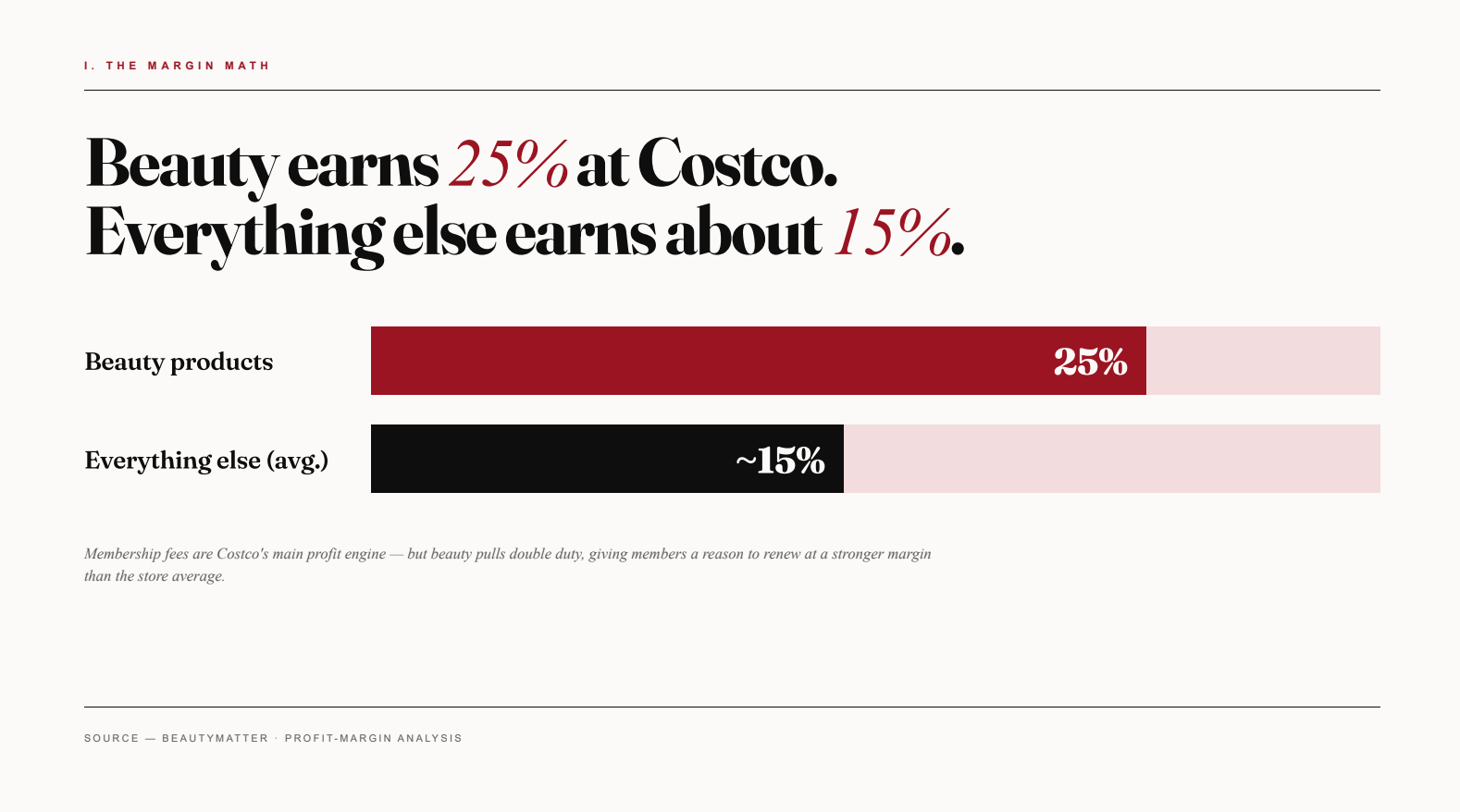
The margin math explains why beauty became a priority. Beauty products earn about 25% profit margins at Costco. Everything else in the store averages closer to 15%. Since Costco makes most of its money from membership fees, beauty pulls double duty: it gives people a reason to renew, and its stronger margins help keep the business running. It is, in the words of BeautyMatter, the company’s “ticket to attract a younger audience.”
The brand evidence goes back to 2007, when StriVectin became a direct Costco partner after the wholesaler actively sought them out. CEO Joan Malloy later reflected that at the time, “the club channel was not seen as a destination for a $139 moisturizer, and some in the industry questioned why a prestige skin-care brand with an already booming business would enter the channel, just as luxury brands questioned going digital in the early days.” The K-beauty assortment launched around 2017; J-beauty followed in 2019. And as Glossy reported in October 2020, by the time everyone was stuck indoors with nothing to do but buy in bulk, Costco had already built the infrastructure.
She Trades Up and Down
Almost half of new Costco member sign-ups are now under 40, a number CFO Gary Millerchip confirmed on the Q4 2025 earnings call; that single demographic shift explains more about what is on those shelves than any merchandising decision. On the Q2 2026 call, Millerchip added more detail: “At Q2 end, we had 40.4 million paid executive memberships, up 9.5% versus last year. We ended the quarter with 82.1 million total paid members, up 4.8% versus last year and 147.2 million cardholders, up 4.7% year-over-year.” Consumer Edge dug further into the data: a greater share of new customers now fall under 34 than in the overall base, indicating that the newest Costco members skew significantly younger than the warehouse’s legacy shoppers.
The membership price hike to $65 at the end of 2024 counterintuitively reinforced this shift rather than reversing it. Placer.ai analysis suggests that raising the cost of commitment filtered out casual shoppers and deepened engagement among members who do the math and visit more frequently to justify the fee. More than four million new members still joined in 2025 despite the increase. NewBeauty’s analysis of over one million Costco customer reviews tells you exactly who those members are: the top two rated beauty products in the entire store are the Obagi Medical Professional-C Serum and Hero Cosmetics Mighty Patch, both scoring over 91% five-star reviews. The member who signs up at $65 and then finds prestige skincare at warehouse prices is not doing something accidental. That person has been deliberately recruited through a decade of category-building.
This is the shopper that retail strategist Robyn Waters saw coming in The Hummer and the Mini, a foundational trend-and-insight book we read early in our careers and return to often. Its core argument still holds: trends run in equal and opposite directions simultaneously, and the consumer who trades up and trades down is not confused. That person is the most sophisticated shopper in the room. Waters wrote this in 2006: the Costco beauty aisle is the proof.
The Moment Was Earned
Prestige Beauty didn’t need Costco. Circana’s 2025 numbers show the category up 4% to $36 billion, and the brands winning are those delivering quality at a price that feels earned, not marked down. Only 14% of US beauty buyers believe higher prices indicate better quality, and more consumers are shifting to value-driven retailers without trading down on brand.
The same logic runs through supplements, ingestible beauty, and menopause care, categories that spent years on the margins of mainstream retail and have now crossed a threshold that is not reversing. The US menopause market alone is projected to hit $8.58 billion by 2033. Costco isn’t dragging any of this downmarket. It is where proven things go to scale.
GLP-1 tells you everything you need to know about how Costco thinks. Weight loss was the most searched term among Costco members seeking primary care. Costco partnered with Sesame to offer Ozempic and Wegovy programs at $179 for three months and struck a deal with Novo Nordisk to make GLP-1 medications available at roughly half the usual retail cost. They saw what the member needed and built the infrastructure to deliver.
Why It Matters
Costco is not Zitomer or CAP Beauty, and it was never trying to be. It is where products land after they have already won. The hype has settled, the repeat purchase is real, and the consumer has decided. Scale, done right, does not strip a product of its edge: it extends it. The original insider still sees the signal, and a new, adjacent consumer comes into the fold. Prestige maintains its cult status at a better price. Wellness categories that once required explanation now require only a shelf position. The member driving all of it is still the one the industry keeps underestimating. She was never waiting for permission. She was waiting for the right product at the right price!
This is Part One of a two-part look at Costco as a cultural force in beauty and wellness. The strategy, the member shift, and the market conditions that made this moment inevitable are all here. The receipts are next week! If anyone works at Costco Beauty, or knows someone who does, we would love to talk!
