


We have sat in many a marketing meeting and read the coverage: fragrance layering seemingly continues to arrive the same way: as a scent wardrobe story with a combining kit attached. What almost none of it touches is where the dollars moved while everyone was busy describing the habit via TikTok report.
For nearly two decades we have partnered with fragrance and beauty clients on mood and evocation, on what a scent should make someone feel and which memory it should pull on. Consumers write that brief for themselves now. Michelle also finished Advanced Perfumery at Pratt, taught through the French school Cinquième Sens, where the first lesson is that describing what you smell means learning a language that barely exists. Emotion fills whatever the words cannot, and a brand can write into that gap however it likes.
Circana lists scent layering among the forces reshaping fragrance, and the category has climbed to 28% of prestige beauty sales, remaining a bright spot for many. Here are the receipts.
The Tin That Beat The Campaign
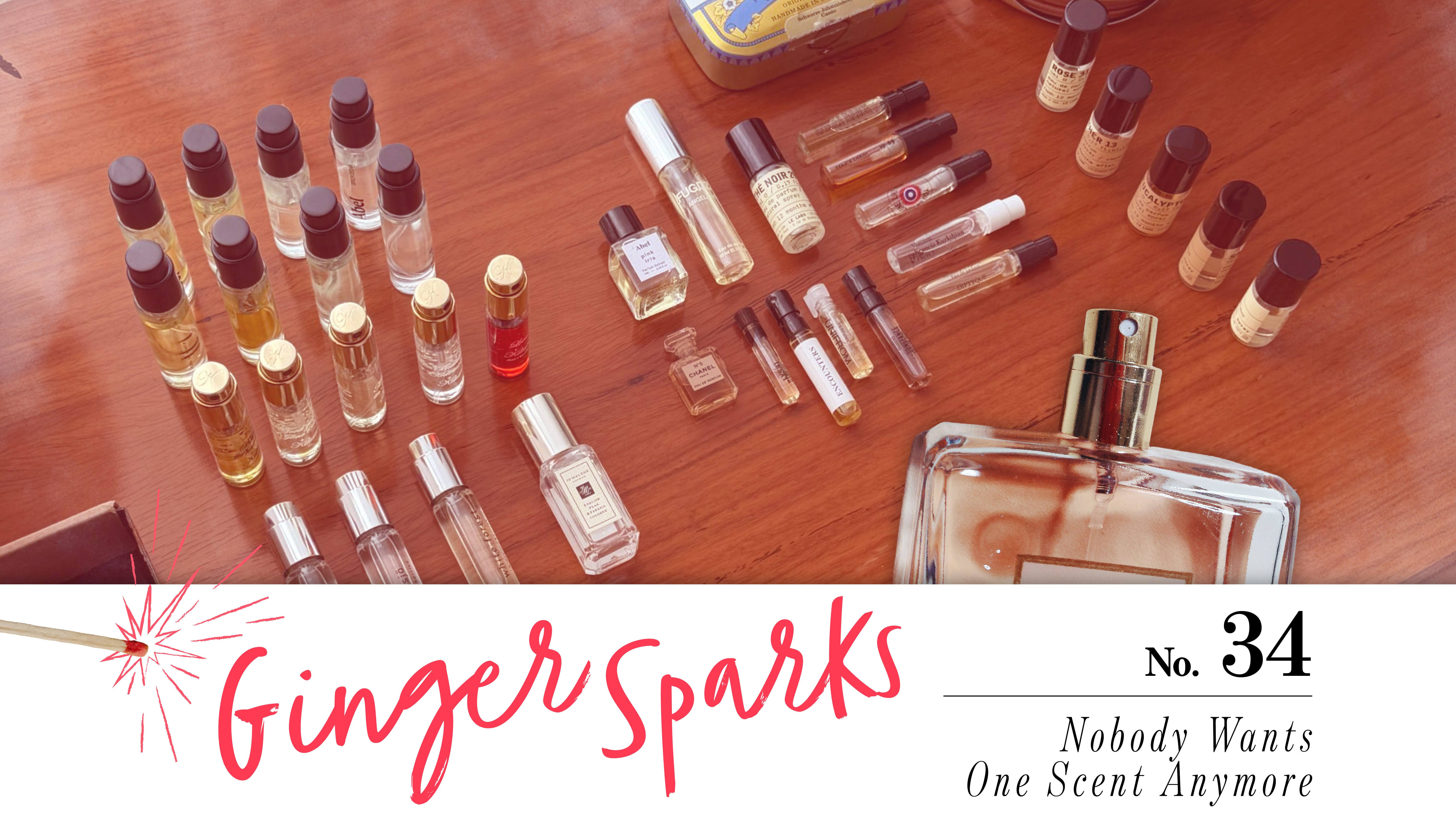
We are both advanced beauty users and, yet, complete commitment phobes about fragrance; we hoard samples and minis and throw a handful in the vanity case whenever we travel, as though a week away might turn us into someone else who wears a different signature scent. You have to admit it’s a great time to try something else on!
In July, Esteban G Villanueva, beauty editor at Vogue Portugal and grooming editor at Esquire Portugal, wrote a piece for Wonderland about dumping his perfume samples into an old mint tin and sorting them by situation rather than by note or brand. One for the commute, another for the office, and one that we particularly loved: filed under poor decisions. He spent nothing to build it, which is the part that matters, because layering gets dismissed as a tactic to sell a second bottle. Here it shows up with no bottle sold at all.
Villanueva is not the only one feeling this way. Unilever surveyed 2,000 adults and found that eight in ten Gen Z respondents pick products based on how the scent makes them feel, with nearly a third layering already under the name "smellmaxxing". ( A term that perplexed us for the longest time). An Axe survey ranked how someone smells just behind their outfit as one of the things that make them feel confident walking into a room. This tracks. Unilever owns Axe, so read both accordingly. Jo Malone London has been formulating for this since long before it had a name, using fewer raw materials per composition so two scents stay legible against each other, and now sells a three-piece Scent Layering Kit of 9ml combiners meant to sit on top of a bottle you already own.
The objection often comes from the people who build the compositions. Perfumer Ayala Moriel argues that a fragrance should arrive as “a complete work of olfactory art that does not require any boost,” and she has a point, because most formulas were never built to take a partner. A composition gets balanced across evaporation rates, and a second spray drops two sets of top notes onto the same patch of skin. Michelle’s professor at Pratt spent his career as an evaluator, judging submissions against a brief, and said the same thing from the other side of the desk. A composition resolves on its own across the hours it was built for, or it fails.
We are inclined to agree with him. In what other category would we accept a product that cannot deliver on its own promises? A face cream you have to layer with a second cream to see results is a face cream that did not work. And yet we do not believe in stifling creativity or telling people how to wear something either. Which is what makes a 94% jump in mists and a third of Gen Z layering already so uncomfortable to argue with.
Because the counter-argument assumes the day is not dynamic, and that the buyer can afford to be wrong. The commute, the meeting, and the drink afterward call for different evocations, and at roughly $300 for a niche 100ml, picking one in advance is a VERY expensive guess.
Ginger Spark: The routine of layering hands’ authorship onto the wearer, so a range not built to be mixed may push fragheads to pair you with someone else’s bottle.
Everyone Is Building On The Same Base
Jamie goes for more sophisticated gourmands, the saffron in Victoria Beckham’s San Ysidro Drive or the tonka in Diptyque’s Orphéon. Michelle reaches for Kenzo’s Cèdre Secret, classified as a powder, and Costa Brazil’s Aroma in Oil, which sits on amber and musk and, on the bottle, tells you to “roll it, layer it, evolve with it.” Four bottles between us, and every one of them warm at the bottom. ( Are you sensing a pattern here?)
Vanilla and amber evaporate slowly and linger for hours while lighter notes burn off first, which is why a composition puts them at the base. The same seems to hold across two bottles, with the warm one settling underneath and becoming the thing every other choice has to accommodate.
Brands are moving toward that position. Gourmand has driven recent momentum at Le Labo and Kilian Paris, and this month Estée Lauder put the lesson on its flagship with Glimmer, the first gourmand the brand has made in eight decades of perfumery.
The value end is doing the same thing more literally. Cyklar sells perfume oils at $24 in four- and eight-piece layering sets, with 13 scents built around single notes across body wash, oil, and cream, so a single note arrives as a component rather than a composition and the customer supplies the rest.
Ginger Spark: Whoever owns the bottom of the stack is in the room for every purchase above it, so build the base or name the one you want to sit on.
The Wardrobe Was Never Made Of Perfume
We were on this one a decade ago. In “Hair Perfume Is a Lazy Girl’s Best Friend”, the New York Post talked to us, then working for a consulting agency, about the arrival of hair perfume, and the pitch back then was functional, with UVA and UVB protection, color-fade protection, and nourishing oils. The category has since grown into the fastest-moving piece of prestige fragrance by dropping that argument entirely. Circana put hair and body mists at $474 million in prestige in 2024, up 94% in a year, at an average price of $25, which is a prestige category priced like a drugstore one.
Sol de Janeiro built the model by selling Cheirosa 62 as a mist, an eau de parfum, a body cream, a hair oil, a hand cream, and a deodorant, then recommending you wear several of them at once. Harper’s Bazaar now suggests spritzing its Cheirosa 40 through drying hair, while plainly noting that the product delivers no hair benefit and exists only to smell like a beach vacation.
The brand is no longer treating any of this as an entry ramp. Sol de Janeiro launched solid perfumes designed to layer with its mists in February, a men’s cologne mist line in July, and is now releasing intensified versions of its own scents, a strategy borrowed straight from the extrait end of luxury. Chief brand officer Elodie Saxemard says body fragrance is “no longer a secondary or entry-level category,” with customers now weighing notes, concentration, and longevity the way they would with a fine fragrance. Byredo and Penhaligon’s have both moved into the format, and YipitData shows Ouai and Phlur taking share while Sol de Janeiro’s grip on the category slipped from 95% to roughly 77%.
Ginger Spark: Nobody is choosing between two scents; they are assembling a ritual, so a house that sells only the eau de parfum is competing for one slot in a stack of four.

Tell us what’s at the bottom of your stack in the comments, then restack this for the friend still loyal to one bottle.
Follow along: gingergeisty
Want to work with us? gingergeist@gmail.com
Not subscribed? Next one lands first in your inbox.
