
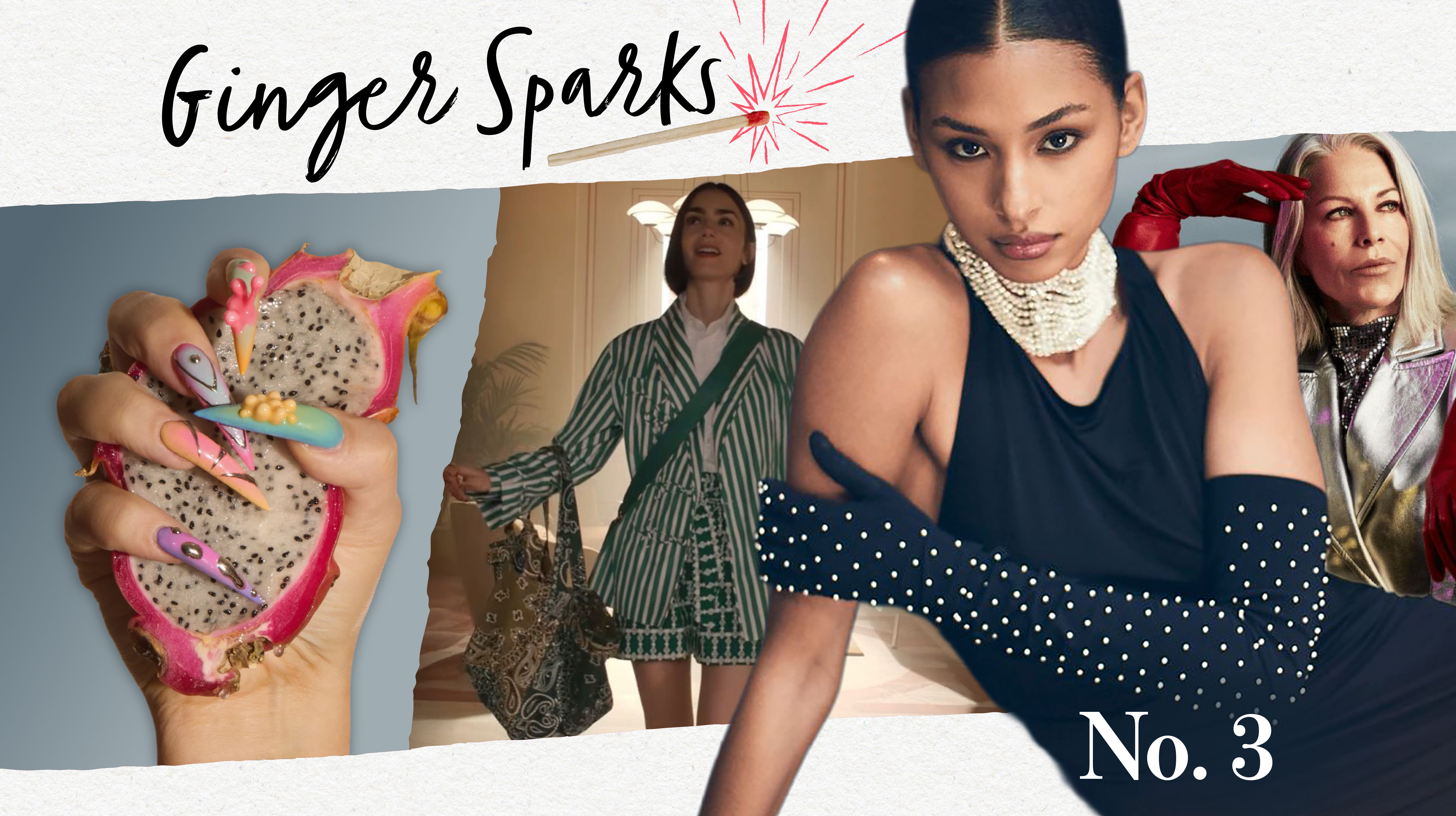
Ginger Spark No. 03
First signals worth watching before they catch fire: modular digits, lady gloves, and big bags.
Modular Nails, Finally!
Nails showed up last week as culture. They show up this week as infrastructure! Demand hasn’t slowed, but most innovation over the past decade focused on aesthetics and technique rather than format. DIY nails got better, not easier. Chrome finishes, cat-eye effects, BIAB, and Russian-inspired precision elevated results, while the underlying system stayed the same: glue, gel, curing, removal, repeat. Press-ons reintroduced convenience, but still relied on adhesive and commitment.
Clip-on nails signal the next leap. Instead of glue or long-term wear, these systems introduce modularity. NIBL Nails is developing a base-free clip-on system and is currently awaiting patent approval, with early demos circulating on TikTok. Kitumi, one of the earliest players in interchangeable nails, has paused new painted set releases to refocus on improving its clip-on mechanism, with a Version 2.0 expected this spring. Modul Nails takes a hardware-like approach with a permanent base and swappable tips, and is currently raising funds on Kickstarter as it prepares to scale
Notably, this next wave is emerging outside traditional beauty pipelines. These brands are building in public, using social media and crowdfunding to prototype, iterate, and test demand in real time. Different paths, same idea. Nails designed for flexibility, repetition, and choice. Less glue. Less commitment. More control.
The Return of The Opera Glove?
It’s Rita Hayworth in Gilda. Pretty Woman. Jessica Rabbit. Long gloves, controlled glamour. And a suspicious number of redheads. *Wink Wink* Now the hands are covered again: on red carpets, in editorials, across Substack mood boards. Gloves are replacing skin as the focal point. This shift feels intentional.
Opera gloves are re-entering fashion not as costume, but as authority. Recent coverage frames their return as a way to add drama and polish to pared-back looks, especially as jewelry and heels step back from their primary status as signals. The signal shows up in repetition rather than hype. Long gloves have appeared across recent runway collections and couture presentations, styled against minimal silhouettes where restraint, not exposure, does the work. That momentum is starting to show up in early data as well. Pinterest Predicts flagged “opera aesthetic” as a rising trend for 2026, with searches up 55% year over year, reinforcing that this return isn’t limited to styling moments, but part of a broader shift toward theatrical elegance and dressed-up details.
Brands are translating that energy for today. Nour Hammour, a name we’ve seen repeatedly on Substack, treats extra-long leather gloves as modern armor. In Paris, heritage glove maker ACABA Gantier pushes the category forward with saturated color and craftsmanship. In New York, Wing and Weft reframes opera gloves as everyday statement pieces rather than red-carpet-only accessories. Across retail and styling, gloves are being positioned as core accessories rather than seasonal novelties. In an era defined by casualization and constant exposure, gloves feel deliberate—covered hands bring the drama back.
Bag Lady, Reconsidered
Confession: Jamie and I used to schlep giant bags everywhere. Post-pandemic, we swore we never wanted to see one again. Lately, though, they’ve been growing on us again. Cue Bag Lady by Erykah Badu. That’s probably why the Call It By Your Name bag grabbed our attention at Beaumarchais in Paris. We kept coming back to it. The bandana prints, the mix-and-match panels, the soft, practical shape: a market bag with a point of view!
The balance feels rare. American iconography, filtered through a Parisian lens. Very IYKYK! Relaxed, graphic, and expressive without tipping into nostalgia. That tension is built into the product itself. The bandanas are sourced from one of the last remaining bandana factories in South Carolina, then hand-embroidered in Europe and assembled across Paris, France, and Poland.
Over time, the bag quietly expanded its reach, moving from boutique discovery to Net-a-Porter and Bloomingdale’s in the US. Most recently, it appeared on Emily in Paris in an olive colorway that has since sold out. Under costume designer Marylin Fitoussi, the show continues to spotlight independent brands alongside global ones, translating on-screen styling into real-world demand. At its core, it’s a great everyday bag. Easy, expressive, and functional. Proof that when independent design meets the right cultural platform, quiet favorites can scale without losing their character. We’ve already added to cart!


