


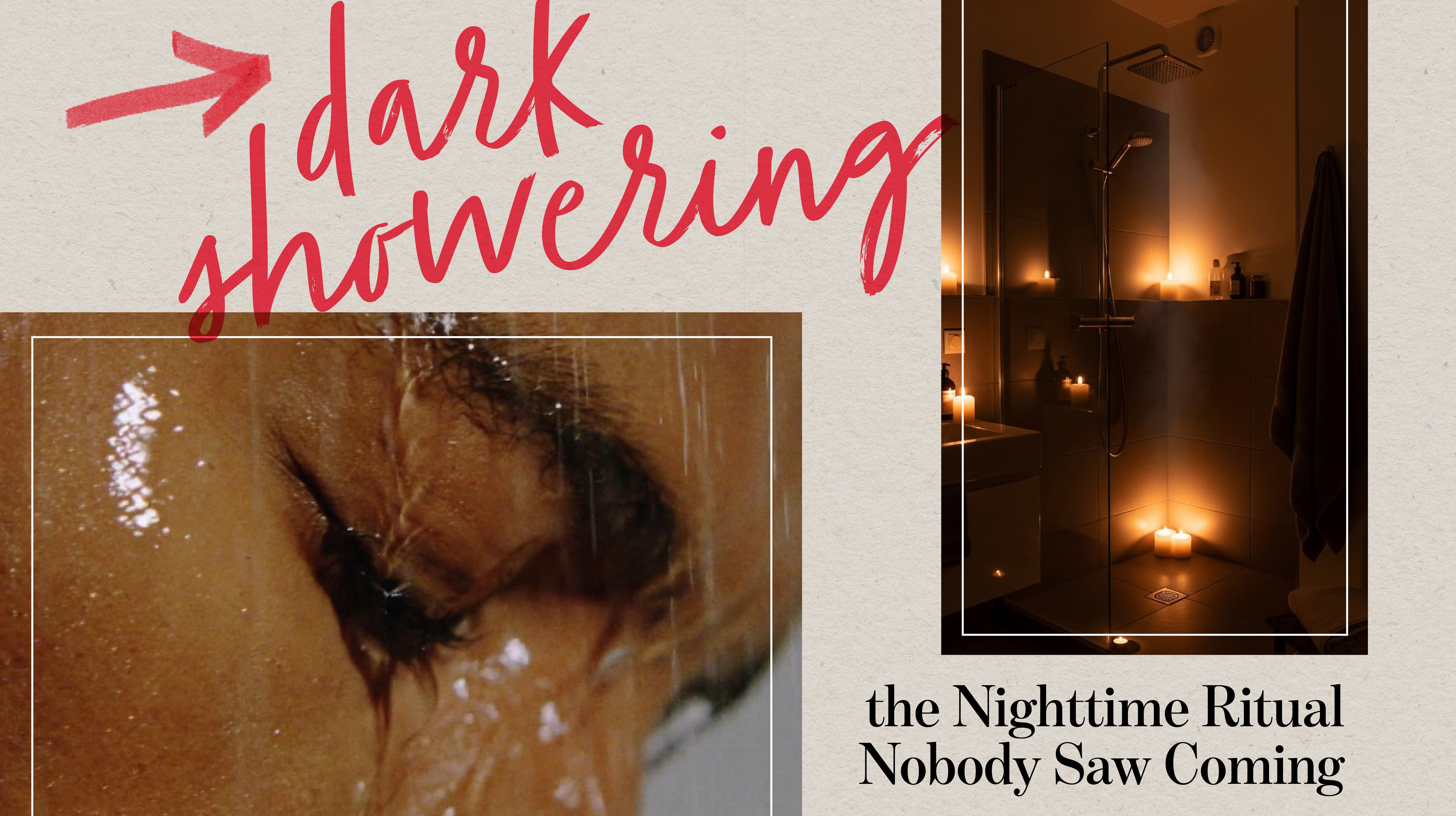
For something that looks so atmospheric on TikTok, the dark shower is surprisingly low-concept. Creators have been posting candlelit bathroom videos under the banner of “nervous system reset,” and the actual argument is simpler than the aesthetic suggests: the harsh overhead lighting most people end their day under is quietly working against them, and turning it off costs nothing.
The science holds up. Harvard Medical School researchers found that blue light suppresses melatonin for roughly twice as long as other wavelengths, and a study in Frontiers in Neurology found that evening blue-light exposure can completely suppress melatonin secretion. The aggressively lit vanity mirror most people stand in front of during their nighttime skincare routine is actively working against the sleep they are trying to protect.
Dark showering lands because it fits a larger consumer shift away from optimization-heavy wellness and toward something more sensory: softer lighting, quieter environments, less stimulation before bed. It sits in the same conversation as magnesium mocktails, sleep-maxxing, and sauna culture. The candle is almost beside the point. What people are responding to is the atmosphere and the permission the darkness gives the nervous system to stop, finally.

The Part Where We Cite Our Sources
The warm water piece is where it gets genuinely interesting, and there is real science to back it up. Researchers at the University of Texas at Austin published a meta-analysis in Sleep Medicine Reviews, finding that a warm shower or bath taken one to two hours before bed reduced the time it took participants to fall asleep by about 36 percent, with sessions as short as 10 minutes producing measurable results. The mechanism is counterintuitive: warm water does not make you sleepy by warming you up. It draws heat toward the skin’s surface, triggering a drop in core body temperature that the brain reads as a green light for sleep. Full-body immersion in a warm bath arguably accelerates the effect, since more surface area is involved; that is also why climbing out of a hot tub at night feels like a sedative. Pair that with the melatonin-preserving effect of dimmed lighting, and you have two things that work independently, suddenly working together. One note worth keeping: water that runs too hot raises heart rate and undoes the whole thing, so pleasantly warm is the actual target here.
Wellness: The Wind Down
Here is the thing the wellness industry probably does not want you to clock: you already own everything you need. A candle, warm water, and ten minutes of genuine quiet will outperform most of the sleep products currently sitting on your bathroom shelf. The upgrade comes from leaning into the sensory environment you have already created, and that is where scent starts to matter.
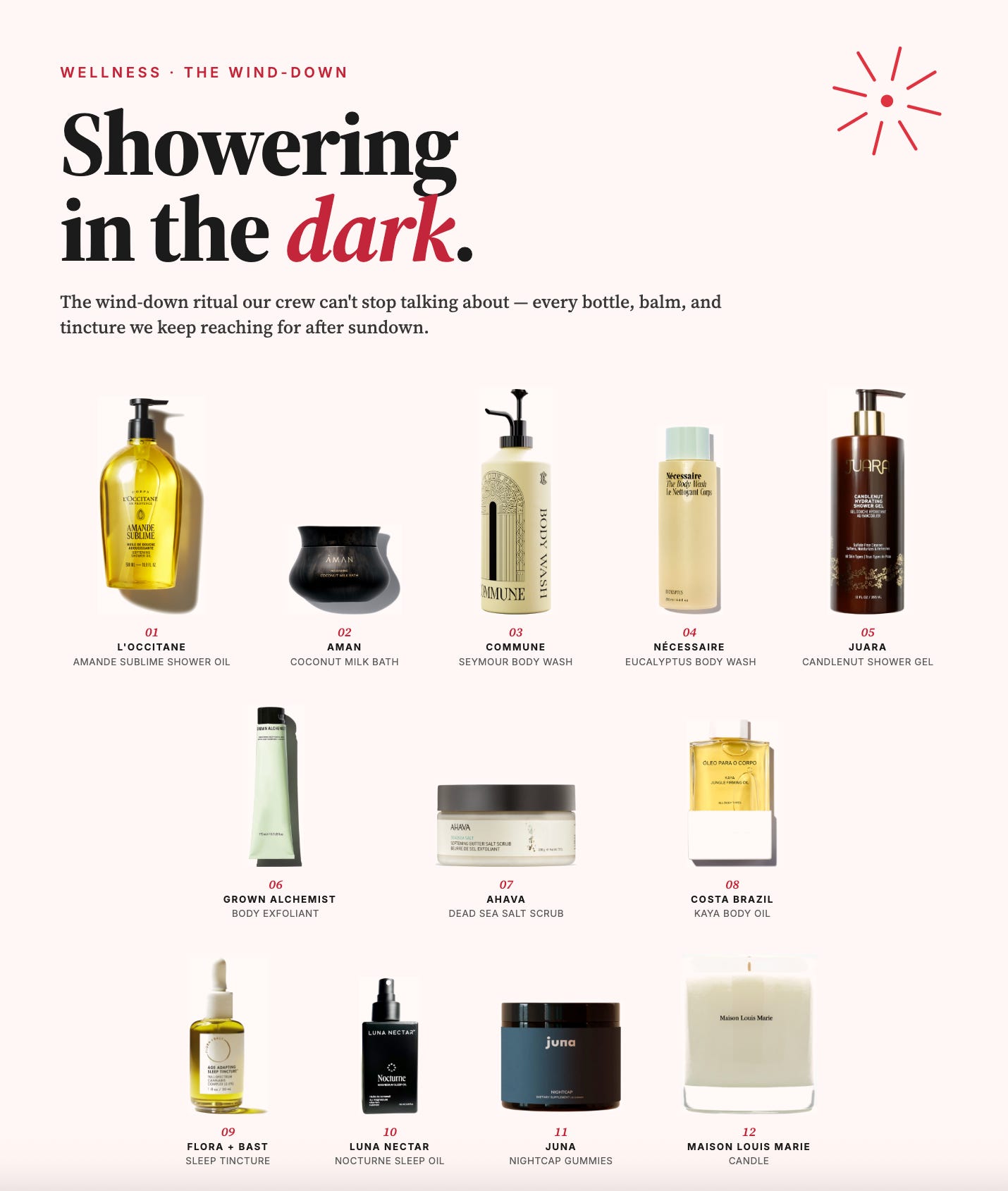
The candle is not decorative here; it is functional. The Maison Louis Marie No. 02 Le Long Fond is the one we reach for: cypress, sandalwood, and amber in a clean coconut-and-soy wax blend that burns quietly and smells like somewhere you actually want to be. Place it on a stable shelf before you get in, and let the overhead light stay off.
In a dark shower, fragrance does more of the work because you have removed most of the other stimuli, and warm, grounding compositions suit the environment better than anything bright or sharp. The L’Occitane Almond Shower Oil pours as oil and turns milky the moment water hits it, giving it a slippery, skin-coating texture that feels more like a treatment than a wash. The scent is warm almond and bergamot, and it stays with you. Another favorite that we once discovered at Credo but now buy direct is the JUARA Candlenut Hydrating Shower Gel, which draws on the Indonesian Jamu wellness tradition and is warm and botanical without the generic tropical read. Michelle is sensitive to fragrance and always comes back to this one.
For those who prefer something more functional, Violet Grey carries two worth knowing about. The Nécessaire Body Wash in Eucalyptus brings marula, cacay, and meadowfoam oils alongside niacinamide and vitamins A, C, and E in a formula specifically developed to be non-irritating, with a eucalyptus scent that reads calm rather than sharp. The Commune Seymour Body Wash at $90 is the elevated option, featuring sea buckthorn and plant oils, lemongrass, and grapefruit. It arrives in a bottle beautiful enough that you will want it on the shelf even when it is empty. Yes, we are talking about showering in the dark, but the aesthetic still counts. The scent runs brighter than the others here, which is worth knowing going in.
If you are drawn to the warm bath over the shower, the Aman Nourishing Coconut Milk Bath, also at Violet Grey, is the most considered option in this space. Mineral-rich salts, jasmine oil, and coconut milk are designed for a 15-minute soak that leaves skin silky and the mind genuinely quieter. At $115, it is a commitment, but it is also the closest thing on this list to a hotel experience you can recreate at home. (If you missed stocking up during the recent Put It In The Bag sale, this is the kind of edit worth bookmarking. Violet Grey typically runs two sitewide events a year, with the next one likely landing around the holidays.)
Exfoliation earns its place in the dark shower for reasons beyond skin texture. The slow, circular motion of working a scrub into skin activates the same nerve pathways as massage, lowering cortisol and nudging the body further into parasympathetic mode. Even the word scrub feels like permission to slow down. We talk about the AHAVA Softening Butter Dead Sea Salt Scrub a lot around here, and no, they do not pay us, but we are about to reach out! It is so luxurious that we always want to indulge, starting dense before melting into a light lotion on contact with water, mandarin, and cedarwood, keeping the whole thing grounded. The Grown Alchemist Smoothing Body Exfoliant is more of a weekly skin-prep than a nightly ritual, but worth keeping in the rotation for what it does to the skin’s surface before everything else lands.
After stepping out, damp skin is the moment, and we mean that. Warm water makes fragrance more immediate and absorption more efficient, which is why a body oil applied here consistently outperforms the same product on dry skin. The Costa Brazil Kaya Jungle Firming Body Oil is the one we keep coming back to, built around breu branco resin, used for centuries to reduce stress, in a woody, grounding scent that does its job without announcing itself. We reach for it every time and have never once regretted it.
As the ritual extends past the bathroom door, magnesium is worth adding to the sequence. We picked up the Healing Feels Transdermal Magnesium No.1 at WTHN, the New York acupuncture and wellness studio, and have not stopped talking about it since. Made by an acupuncturist with sandalwood, turmeric, bergamot, and geranium in a magnesium chloride base, it is sprayed onto the soles of the feet, which are among the body’s most absorptive surfaces, and left to sink in. It is currently sold out, but it is worth checking back. The Luna Nectar Nocturne Magnesium Sleep Oil at the Detox Market is a strong alternative.
From there, the conversation moves to ingestibles, and it helps to know a little history. Standard Dose was the New York retailer that, before it closed in 2023, was one of the better places to discover the CBD and wellness supplement category in a considered way. Standard Dose was also where we first discovered Plant People’s Drops+ Sleep, a CBD/CBN formula we loved enough to buy several bottles of before they quietly phased it out. Several brands from that era are still very much worth knowing. Several brands from that era are still very much worth knowing. Juna Nightcap Sleep Drops were another Standard Dose discovery, full spectrum CBD and CBN with passionflower, chamomile, and mint in a USDA certified organic, melatonin-free formula. Flora + Bast still makes their Age Adapting CBD Sleep Tincture, 300mg CBN and 1,101mg CBD per bottle with lavender, valerian, frankincense, chamomile, and bergamot, taken sublingually 30 minutes before bed. Both worked for us, but as always, consult your own health professional before adding anything new to your routine.
Not Just Vibes
We just gave you a lot of recommendations, and we stand by all of them. But what dark showering actually reflects is something the wellness industry has been slow to admit: that environment is the intervention, not the product. We have spent a decade being sold things designed to help us sleep, calm down, and decompress, and most of them work around the problem rather than at it. Flipping a switch and lighting a candle is not a sophisticated solution–which is exactly why it works!
The Everything Shower comparison is hard to avoid. That ritual, which had a genuine cultural moment in 2023, was built on abundance: every product, every tool, every step mapped out in advance. Dark showering runs in the opposite direction entirely, stripping the environment down until the nervous system has nothing left to process. Both rituals make the same underlying argument: that the bathroom is one of the few spaces in daily life where slowing down is not only acceptable but expected. The difference is in the philosophy. One adds until it feels complete. The other removes until it finally does.
Why It Matters
Dark showering is not just a TikTok moment, and the brands paying attention to it know that. It reflects a genuine shift in how people think about overstimulation and what it ultimately costs them. The near-zero price of entry is part of the appeal, but it also points to real white space for brands in home fragrance, bath and body, and sleep wellness willing to position around the environment rather than just the routine. The products that will earn a place here are the ones that understand they are not the main event. They are supporting the conditions for sleep, and in 2026, knowing the difference between those two things is the whole game.
