


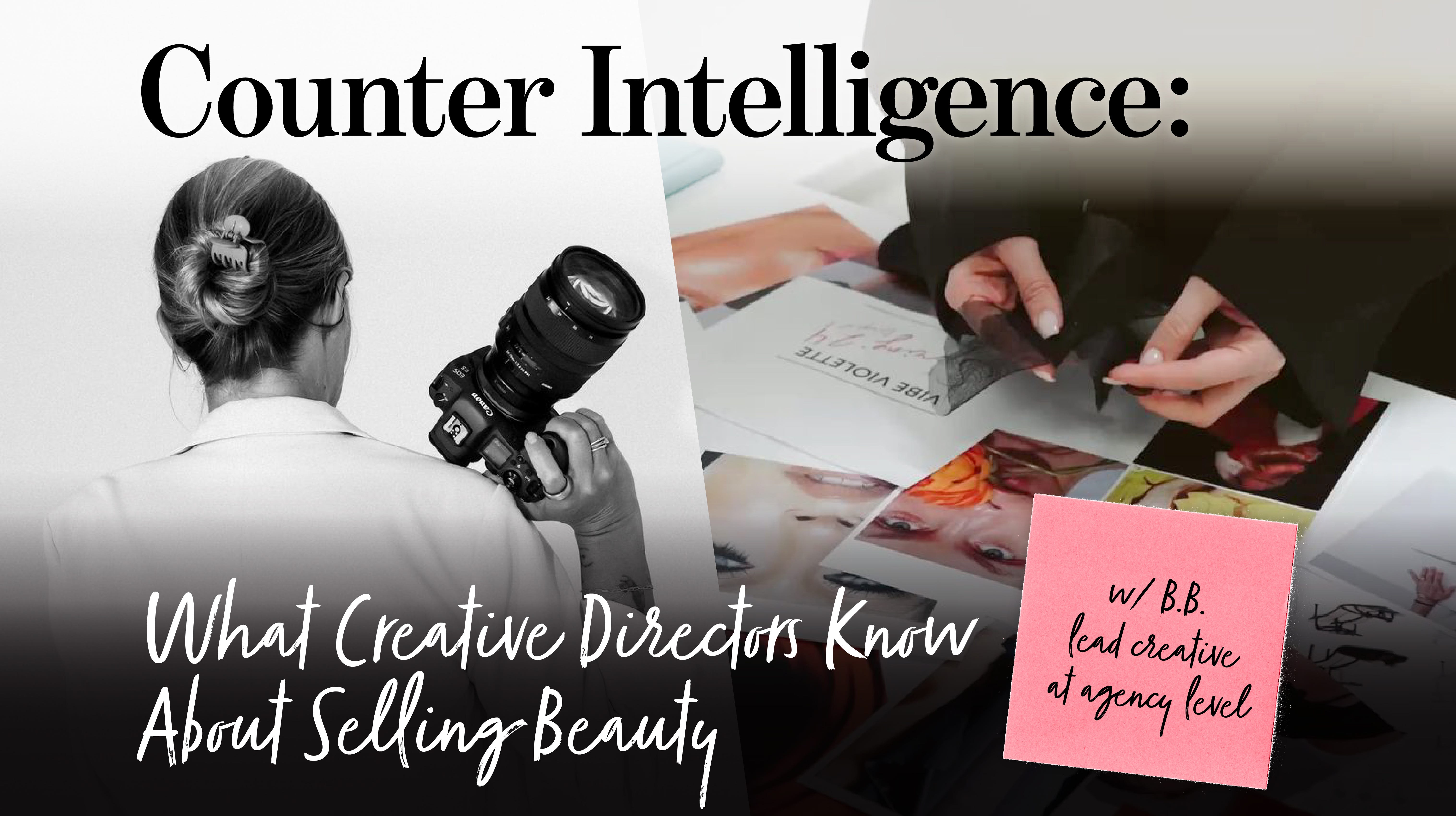
Our lineage is confessional—It Happened to Me, Say Anything, “Confessions of…” —but our beat is business: insiders, receipts, and the plays that actually move units and services. Some interviews are anonymous for candor; roles verified.
The Insider
B.B. spent 14 years in New York, moving from production to creative leadership at the agency level. Across her career, she’s worked in mass market to prestige beauty, overseeing concept, storytelling, and campaign strategy.
Coming up through execution gives B.B. a rare perspective: both the chaos on set and the strategic vision needed to solve it. That’s why what she says about human nature, brand mistakes, and what actually moves performance matters.
The Interview
You started in production and now lead creative at the agency level. How does coming up through execution, not just concept decks, change the way you direct a room? It makes me allergic to fantasy. I love big ideas, but I also know exactly what breaks on set, in approvals, and in the budget. That “execution brain” doesn’t limit creativity; it forces better creativity.
After 14 years in NYC, what’s one thing about this industry that hasn’t changed… even though everyone insists it has? Human nature. Tools change often, but people still want to feel seen, understood, and a little bit elevated. Advertising is still representation at scale, and we still forget there is a real person on the other side of the screen, not a “target.”
You’ve worked across mass beauty and prestige skincare. What’s the biggest delusion both sides of the market still cling to? That simplicity is easy. A mentor once told me: the road to simplicity is not simple. Big brands overcomplicate because there are too many hands and too many opinions. Smaller brands are under-scope because resources are tight. Both can lose the plot in different ways, and both underestimate the compromises required to make something clean, clear, and memorable.
On set: what actually happens that no one talks about? What gets swapped, blurred, over-lit, reformulated, or “fixed in post”? The reality is that on set, you’re constantly managing physics. Reflections, textures, viscosity, label legibility, color shifts under different lighting, and the product behaving like it has free will. The best sets feel calm because the chaos is handled upstream with planning, testing, and the unsexy work: timing and budget!
What’s the craziest situation you’ve ever had to handle on set or during a campaign that people outside the industry would never believe? No names required, but we’d love the story. Every shoot has a plot twist. Weather, shipping delays, a prop that arrives wrong, a location that suddenly has “rules,” someone’s energy changing the whole room. The wildest days usually involve young talent because you’re managing more than logistics; you’re managing psychology. Those days are the most exhausting and also the most satisfying when you land it.
As both Creative Director and Executive Producer, where do you see the most friction? Strategy vs. aesthetics? Client vs. influencer? Budget vs. ego? The biggest friction is when everyone is answering the wrong question. If the brief is fuzzy, everything downstream becomes messy. I spend a lot of time sharpening the actual question first. Once it’s specific, the room relaxes, because now we’re making something real, not just reacting.
When a brand hires an influencer, who is really running the creative? And have you ever watched that power dynamic quietly unravel? The cleanest collaborations happen when the agency sets the creative spine and the influencer brings lived-in delivery, because these partnerships are usually one part of a bigger campaign vision.
The trend cycle now refreshes weekly. Are you building faster, or deliberately resisting speed? Both. We track trends closely, mostly to avoid looking like we arrived late to the party wearing the same outfit as everyone else. If a brand wants to be a trendsetter, it takes strategy, restraint, and a clear point of view. Speed without taste is just noise.
What’s the clearest red flag in a brief that tells you a brand doesn’t know who it is? When the “audience” is everyone and the objective is “awareness AND conversion” with no tension, no point of view, and no decision about what they want to be famous for. A strong brief is specific: who, why now, what is the single change we want, and what must be true for it to work.
You lead 360 campaign development. Where do most brands lose the plot when they try to scale a single idea across every touchpoint? They treat 360 like copy/-paste instead of a system. A real 360 idea has rules, roles, and a toolkit so every touchpoint feels different but unmistakably related. The campaign dies when each channel starts “getting creative” in isolation, and the whole thing ends up as unrelated content.
What’s one creative direction in beauty no one is really funding yet, but should be? Where would you double the budget? Humor in luxury beauty. Not goofy, not meme-y, but intelligent, human, lightly self-aware. Prestige brands are often allergic to levity, even though other premium categories have proven that you can be elevated and still make people smile. I’d double the budget on writing and concept development, because humor isn’t an afterthought. It’s craft, and it’s human nature.
And what’s one visual beauty trend you would eliminate tomorrow without apology? Everything beige.
Have you ever worked on a brand whose product you wouldn’t personally use? What does that disconnect do to the integrity of the work? Early in my career, yes. It taught me the value of saying no. If I cannot genuinely stand behind a product, the work becomes performance. Saying no has been better for my integrity and better for business.
Every brand thinks they’re saying something new. Most aren’t. Is that a product problem, a positioning problem, or a courage problem? Positioning. In saturated categories, products can be similar. People buy meaning, identity, and trust. Most brands default to features because it feels safe. Positioning forces clarity, and clarity takes courage.
What do you think is the most important part of the branding process? Articulating why you exist and what you stand for, in plain language. The “why” is the difference between a brand and a catalog.
And what is the most important part of the branding process that brands consistently let slip through the cracks? The quiet lever that actually determines longevity. Discovery. Real research, real conversations, real tension. Brand positioning exploration and manifesto work, both consumer and trade. Most brands rush this and then spend the next year paying for it in content that does not land.
You’ve worked on legacy brands and niche prestige labels. Who is braver right now, the heritage brand trying to stay relevant, or the indie brand trying to look established? Heritage brands, when they actually commit. Indie brands can take swings with less risk. Legacy brands have more to lose and a bigger stage, so when they step outside their comfort zone, the impact is greater. Bigger risk, bigger reward.
What’s a moment in your career where the smartest creative decision was the least flashy one? Something that didn’t scream, but worked. Choosing a single, strategic spine and repeating it with discipline and not chasing novelty, not over-producing. A lot of creatives hate that because it feels “too simple,” but simplicity compounds. The loudest campaign is not always the one that lasts.
Beauty loves the word “authentic.” What does authenticity actually look like on set, and when is it just performance? Authenticity is alignment. The casting, tone, language, pace, and visuals should feel like the brand’s real personality, not borrowed. It becomes performance when it’s just a costume on top of the same old playbook.
If you walked into a brand tomorrow and could change one structural thing, not a campaign, not a shoot, what would you overhaul first? Decision-making. Fewer approvals, clearer ownership, and the right mix of perspectives in the room. Too many voices flatten. The wrong voices misdirect. The right few voices create speed and truth.
Do you get high on your own supply? Name the product or service you personally use weekly — and one you skip, even though you’re “supposed” to love it. Weekly: a mud mask, always. It’s the reset button, especially in NYC. Skip: complicated 10-step routines and anything that turns skincare into a second job.
Last confession: What’s one true thing about the beauty industry that would get you yelled at in a meeting — and what’s the receipt that proves it? Results aren’t driven solely by the product. The product’s creative representation drives them. Receipt: I’ve watched tiny shifts in messaging, casting, and visual language move performance more than “new and improved” claims ever did. People don’t just buy chemistry. They buy a story they believe when they’re looking at themselves in the mirror.
We’re gathering intel from the people who actually keep beauty moving—product developers, sales teams, educators, artists, practitioners, and anyone working in the beauty industry. Got receipts, confessions, or a truth from the front lines? Send it to gingergeisty@gmail.com
